
You've been up since 6 AM. Your whiteboard is covered in crossed-out domain ideas. You've checked forty-seven .com variations on GoDaddy. All taken.
Your co-founder suggests hiring a naming agency. "They're experts," she says. Then you see the proposals. $15,000. $35,000. One boutique firm wants $50,000.
Here's the question nobody wants to answer honestly: Is that $50,000 worth it? Or can a $10 AI tool actually do the job?

What a Branding Agency Actually Charges
Let's start with cold, hard numbers.
According to Knapsack Creative's 2025 Branding Pricing Guide, branding project costs vary significantly by agency tier:
- Boutique studios: $5,000 - $20,000 (includes discovery, strategy, logo, messaging framework)
- Mid-tier agencies: $20,000 - $50,000 (adds competitive research, comprehensive guidelines)
- Premium agencies: $50,000 - $200,000+ (full brand transformation with rollout support)
And that's just the price tag. The timeline is equally sobering.
Naming projects typically take 4-6 weeks for "fast-track" engagements, 8-12 weeks for standard projects, and 3-6 months for comprehensive brand development. As one agency puts it: "A branding process can take between 4 weeks and 14 months."
That's not a typo. Fourteen months.
What You Get for $15,000
To be fair, agencies aren't just picking names out of a hat. A typical naming engagement is a structured, methodical process.
Here's what you're actually paying for:
-
Discovery & Research (2-4 weeks) - Stakeholder interviews, market analysis, competitive landscape mapping. The agency conducts internal workshops to understand your vision, values, and target audience.
-
Strategy Development (1-2 weeks) - Positioning workshops, naming criteria development, creative brief. This phase defines what makes a "good" name for your specific business.
-
Name Generation (2-4 weeks) - Brainstorming sessions, creative development, initial screening. Teams generate hundreds of candidates internally before narrowing down.
-
Screening & Validation (1-2 weeks) - Preliminary trademark checks, domain availability scanning, linguistic screening across target markets. This eliminates obvious legal conflicts.
-
Presentation & Selection (1-2 weeks) - Shortlist presentation with rationale, stakeholder feedback rounds, final selection meetings. Often involves multiple rounds of refinement.
-
Legal Clearance (2-4 weeks) - Formal trademark search through legal counsel, comprehensive risk assessment, final legal opinion.
The deliverable? Typically 3-5 final name candidates with strategic rationale. That's roughly $3,000-$5,000 per name option.
The process is thorough. The timelines are real. The question is: do you need all of it?
What AI Tools Actually Provide
Modern AI naming tools compress the traditional agency process into a fundamentally different approach. Tools like URLGenie represent this new category.
The typical AI approach delivers:
- 50-100 name candidates per session (generated based on your brief)
- Real-time domain availability checking across TLDs
- Automated scoring on brand metrics (memorability, clarity, SEO potential)
- Preliminary risk scanning for similar business names
- Instant iteration - run another session with refined parameters
The cost is radically different: $10-50 for unlimited generations vs. $5,000-$50,000 for agency naming.
This raises the obvious question: what's the catch?
The Real Comparison: What Actually Matters
Let's break this down honestly.
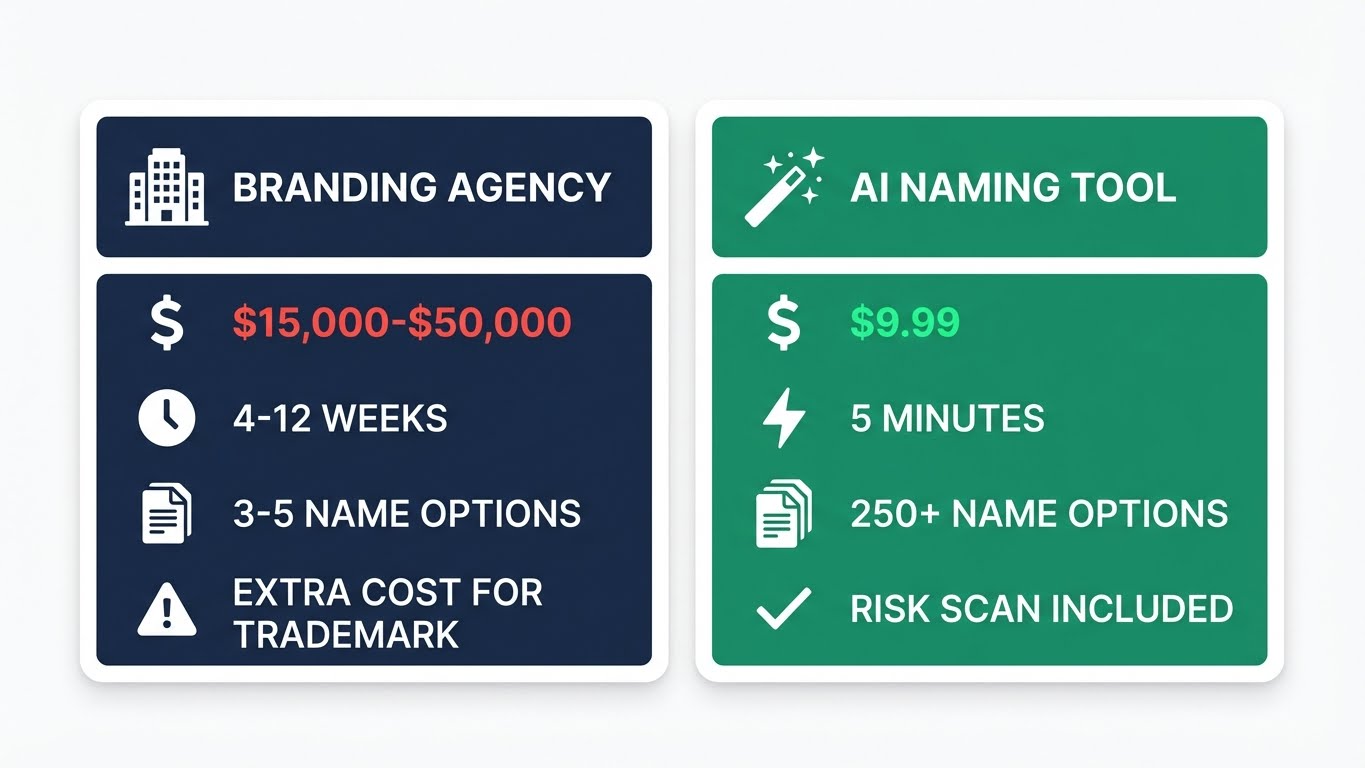
| Factor | Traditional Agency | AI Tool (URLGenie) |
|---|---|---|
| Cost | $5,000 - $50,000+ | $9.99 |
| Timeline | 4 weeks - 6 months | 5 minutes |
| Name Options | 3-5 finalists | ~50 per session |
| Availability Check | Manual, often delayed | Real-time, multi-TLD |
| Risk Analysis | Depends on package | Included (similar business scan) |
| Iteration | Expensive (new engagement) | Included (use remaining sessions) |
| Human Strategy | Yes, extensive | AI-powered with clear rationale |
| Legal Trademark | Often included | Early warning only (not legal advice) |
The agency process is comprehensive, but it's also built for a different era. Before real-time domain APIs, before AI could analyze trademark risks, before you could generate and evaluate hundreds of names instantly.
Where Agencies Still Win
Let me be honest: agencies aren't just overpriced dinosaurs. They provide genuine value in specific situations.
Agencies make sense when:
- You're a Series B+ company with complex stakeholder dynamics and need facilitated alignment
- You need full-service brand strategy, not just a name - positioning, messaging architecture, visual identity
- You're navigating a sensitive rebrand with legacy equity to protect
- You have a $100M+ launch budget and naming is a small line item
- You need hands-on facilitation and internal alignment workshops
The key question is: Are you in that situation?
For 90%+ of startups, the answer is no. You need a good, available, brandable domain name. You need it fast. And you need to know it won't get you sued.
You don't need $35,000 worth of stakeholder workshops.
Understanding the Trade-offs
The pricing comparison tells part of the story, but there are deeper differences worth understanding.
What you gain with AI tools:
- Speed: Results in minutes, not months. Critical when you need to move fast or validate ideas quickly.
- Volume: See hundreds of options instead of 3-5 finalists. Useful for understanding what's actually available in your space.
- Cost: 1000x cheaper means you can afford to name multiple products, test variations, or explore different directions.
- Iteration: Refine your brief and run again immediately. No waiting for scheduled calls or new project proposals.
What you lose with AI tools:
- Strategic facilitation: No one to guide you through positioning questions or reconcile conflicting stakeholder visions.
- Custom research: AI works from existing patterns, not bespoke market analysis of your specific competitive landscape.
- Legal thoroughness: Preliminary risk scanning isn't the same as a comprehensive trademark attorney review.
- Human creativity: AI excels at recombination and pattern matching but won't have the lateral thinking of an experienced creative director.
The question isn't which is better. It's which trade-offs match your situation.

The Quality Question
The valid concern: "Won't AI names feel generic or derivative?"
This depends heavily on which tool you're using. Early domain generators (GoDaddy, Namecheap, Namelix) largely produced keyword mashups like FastPaySolutions or TechStartPro - names that scream "I couldn't afford better."
Modern AI naming tools aim higher. The best ones generate names that pass the "could this be a real company?" test - names that sound like they could sit alongside Stripe, Notion, or Figma rather than obvious concatenations.
The honest assessment: AI-generated names tend to cluster around "good enough" more consistently than agency names. An agency might deliver one exceptional name and two mediocre ones. AI will deliver 50 names that are mostly in the "solid 7/10" range, with occasional standouts.
If you need a name that's truly exceptional - the kind that becomes part of cultural vocabulary like "Google" or "Uber" - an experienced agency creative director still has the edge. But most businesses don't need iconic. They need available, brandable, and memorable enough.
Real example: When we built URLGenie, we used our own tool to name it. URLGenie.ai scored well on memorability and clarity, was immediately available, and had no risk flags. Is it iconic? No. Is it perfectly functional for a domain naming tool? Yes.
That's the trade-off you're making.
Common Questions About AI Naming
"How do AI tools handle trademark conflicts?"
Most modern tools include preliminary risk scanning that flags obviously similar businesses in the same category. This isn't comprehensive legal clearance - you'd still want an attorney review before major brand launches - but it catches the glaring issues that agencies would identify in their initial screening phase.
"Can AI really understand my brand positioning?"
AI tools work from the brief you provide - your industry, target audience, desired tone, and key differentiators. The quality of output depends heavily on the quality of your input. If you can articulate what you're building and who it's for, AI can generate relevant names. If you're still figuring out your positioning, the structured prompts might actually help clarify your thinking.
"What about domains that are registered but not in use?"
This is a challenge regardless of approach. Whether you're using an agency or an AI tool, if a .com is parked or unlisted, you'll need to decide: negotiate to buy it, choose an alternative TLD (.ai, .io), or pick a different name. The advantage of AI tools is seeing many alternatives quickly rather than waiting weeks for your agency to present new options.
The Honest Verdict
Can a $10 tool beat a $10k branding firm?
For most founders: Yes.
Here's when to use AI:
- You're pre-Series A and need to move fast
- You need a name in days, not months
- Your budget is measured in thousands, not tens of thousands
- You're naming a new product, side project, or early-stage startup
- You want data-driven decisions, not gut feelings
Here's when to consider an agency:
- You're a large enterprise with complex politics
- Naming is part of a broader strategic rebrand
- You have $50k+ allocated specifically for naming
- You need human facilitation for internal alignment
Our Experience Building URLGenie
When we needed a domain name for a naming tool (meta, we know), we tried the traditional approach: spreadsheets, free generators, GoDaddy searches. We got agency quotes ranging from $8,500 to $22,000.
For a bootstrap project, those numbers didn't make sense. So we built what we wished existed - a tool that could generate many options quickly, check availability accurately, and flag obvious risks automatically.
The first session found URLGenie.ai. Not an iconic name, but clear, available, and functional. We registered it and moved on to building the actual product.
That experience - needing a good name fast without spending seed capital - is what most early-stage founders face. It's why we built this tool and wrote this article.
Making Your Decision
If you're choosing between an agency and AI tools, here's the real question: what does success look like?
If success means:
- A name that becomes part of cultural vocabulary
- Extensive stakeholder alignment and facilitation
- Full brand strategy, positioning, and messaging
- Budget and timeline aren't primary constraints
Consider an agency. You're paying for expertise, creativity, and strategic guidance that goes beyond just picking a name.
If success means:
- A solid, available, brandable name you can move forward with
- Speed and cost efficiency
- The ability to explore many options and iterate quickly
- Preserving capital for product development
Try AI tools first. You can always hire an agency later if needed, but you might find what you need in the first session.
Tools like URLGenie exist to help you move fast. Use them when speed matters. Hire experts when depth matters. Most importantly, make the decision that matches your actual constraints - not the decision you think you're "supposed" to make.