
You know keyword-stuffed domains are a bad idea. You've seen enough "FastDeliveryHub" and "SmartAnalyticsPro" names to know they feel cheap. But knowing what to avoid doesn't help you create something better.
The real challenge isn't avoiding keyword mashing - it's understanding what makes a name brandable in the first place, and then actually building one. That's what this guide is for.

What "Brandable" Actually Means
A brandable domain name is one that functions as a brand asset rather than a description. It's distinctive enough to own mentally - when someone hears it, they think of you and only you.
Think about the names that dominate their categories:
- Stripe - not "OnlinePaymentProcessor.com"
- Notion - not "ProductivityWorkspaceHub.com"
- Figma - not "CollaborativeDesignTool.io"
- Slack - not "TeamChatApp.com"
None of these names contain keywords describing what the product does. Yet each one is instantly associated with its category. That's the power of brandability - you become the keyword.
A brandable name has three core properties:
- Distinctive - It doesn't sound like everything else in your space
- Memorable - People can recall it after hearing it once
- Ownable - You can build equity around it that competitors can't copy
Why Brandable Beats Keywords in 2026
The case for brandable names has strengthened considerably. Three forces are accelerating the shift.
Search Engines Penalise Generic Names
Google's John Mueller explicitly cautioned businesses against generic keyword domains in 2025, noting that they make it harder to stand out. When your domain is a generic phrase, you compete against every directory, aggregator, and established player targeting the same terms.
Brandable names sidestep this entirely. When someone searches "Stripe payments," Google knows exactly which entity they want. When someone searches "online payment processor," Google has no idea if they mean your business or the concept itself.
Branded search volume is now one of the strongest SEO signals. You can't build branded search volume with a generic name.
AI Search Changes the Game
The rise of AI-powered search compounds the problem. As recent analysis demonstrates, modern AI search systems actively struggle with ambiguity from generic keyword names. A name like "Best Cloud Solutions" is nearly impossible for an AI to resolve as a specific entity versus a general query.
Distinctive names give AI systems something concrete to anchor to. This matters more every month as search shifts from links to answers.
The Market Has Shifted
According to 2026 domain trend analysis, brandable invented names now outperform keyword domains in recall, shareability, and long-term brand equity. Companies like Perplexity and Anthropic have set the standard - funded startups increasingly choose invented or metaphorical names over descriptive ones.
The domain market reflects this too. Short, distinctive names command higher premiums, while keyword-stuffed domains sit unsold.
The Psychology Behind Sticky Names
Understanding why certain names stick helps you create better ones. There's real science here, not just taste.
Your Brain Judges Sounds Before Meaning
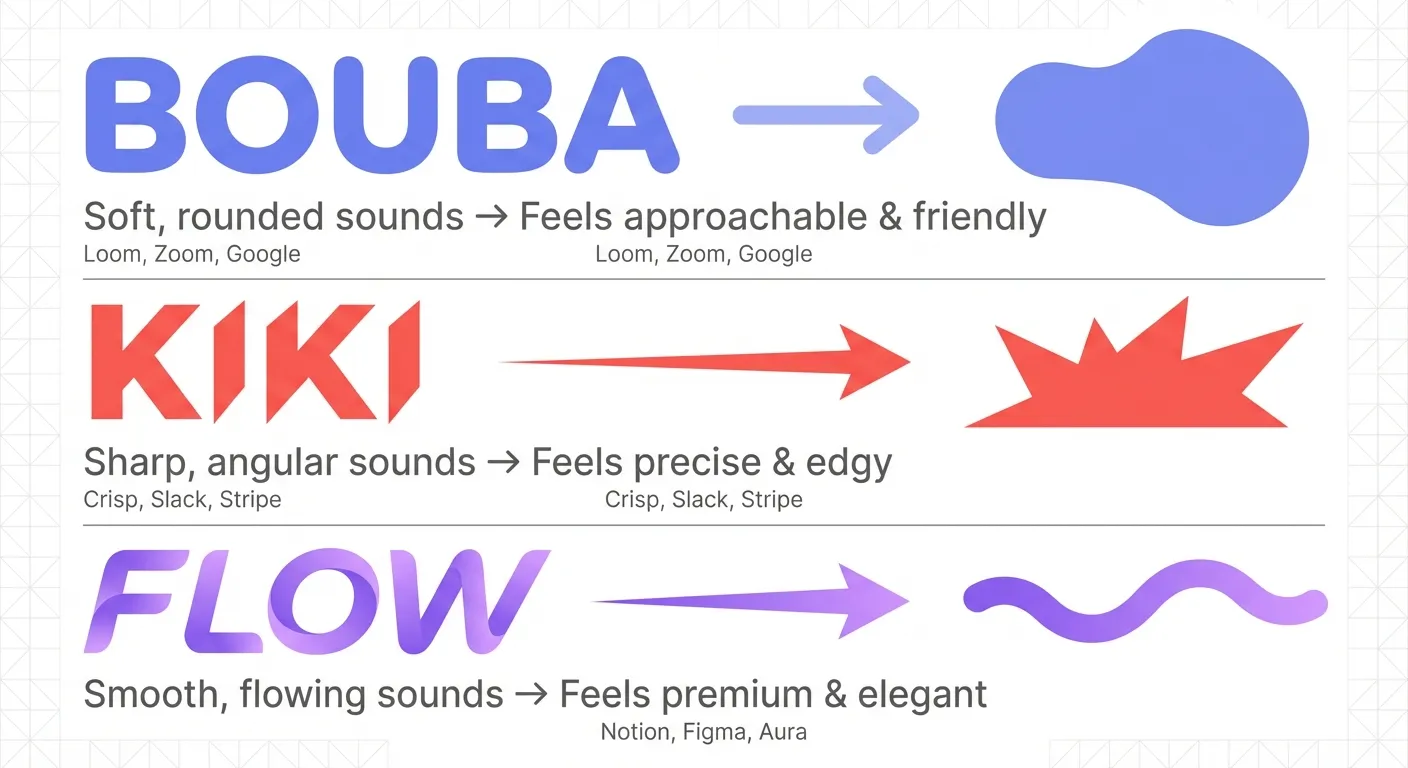
Research into what psychologists call the bouba/kiki effect reveals something surprising: your brain assigns personality to sounds before you consciously process the word's meaning.
Round, soft sounds (like "bouba") feel approachable and friendly. Sharp, angular sounds (like "kiki") feel edgy and precise. This effect holds across cultures and writing systems - it's hardwired, not learned.
This means your domain name creates an emotional impression in milliseconds, based purely on how it sounds. "Loom" feels smooth and flowing. "Crisp" feels clean and sharp. Neither word describes their product, but both feel right for it.
Processing Fluency Builds Trust
Names that are easy to pronounce feel more trustworthy. This is called processing fluency - the easier something is to mentally process, the more positively we evaluate it.
This is why the "radio test" matters so much. If someone hears your name spoken aloud and can spell it correctly on the first try, your name has high processing fluency. That fluency translates directly into trust, recall, and willingness to engage.
Five Techniques for Creating Brandable Names
Here's where we get practical. These are proven approaches for generating names that are distinctive, memorable, and available.
1. Metaphorical Names
Choose a word that evokes your value without literally describing it.
- Amazon - Not "OnlineBookstore." A metaphor for abundance and scale. Jeff Bezos originally chose "Cadabra" (as in abracadabra), but switched after an early stakeholder misheard it as "cadaver".
- Uber - German for "above" or "supreme." Suggests premium without mentioning taxis.
- Headspace - Doesn't say "meditation." Says what meditation gives you.
How to try it: List the outcomes your product delivers, not its features. Then find words, images, or concepts associated with those outcomes.
2. Invented Words
Create a new word that sounds natural but doesn't exist in the dictionary.
- Spotify - No meaning, but feels energetic and techy
- Zapier - Suggests speed and electricity
- Calendly - Borrows from "calendar" but adds a friendly suffix
How to try it: Take a root word relevant to your space and modify it. Add suffixes (-ly, -ify, -io), blend two words, or alter the spelling of a real word just enough to make it distinctive.
3. Unexpected Real Words
Use a common word from a completely different context.
- Apple - Nothing to do with computers
- Slack - The opposite of what a productivity tool implies
- Medium - Repurposed from its meaning as a communication channel
How to try it: Browse a dictionary or thesaurus with your brand's feeling in mind, not its function. What words evoke the right emotion or energy, regardless of their literal meaning?
4. Portmanteau (Word Blending)
Combine parts of two words into something new.
- Pinterest - Pin + Interest
- Instagram - Instant + Telegram
- Groupon - Group + Coupon
How to try it: List 10-15 words related to your business or its benefits. Try combining the first syllable of one with the last syllable of another. Most combinations will be terrible - that's normal. You're looking for the one that clicks.
5. Name + TLD Combinations
Let the domain extension complete the name.
- del.icio.us (early example)
- inter.com (Intercom)
- .ai extensions for AI tools (like URLGenie.ai)
How to try it: Consider whether your name can work with a specialty TLD that adds meaning. This works especially well for tech companies where .ai, .io, or .app carry industry credibility.
The Availability Problem (And How to Solve It)
The biggest objection to brandable names is availability. "All the good .coms are taken."
This is true for obvious words. But it's actually an advantage for the techniques above. Invented words, metaphors, and creative blends are far more likely to be available precisely because they're original.
Some practical strategies:
- Don't fixate on .com alone. Industry-relevant TLDs like .ai, .io, and .app carry real credibility in their sectors. As we explored in our guide to finding available domains, expanding your TLD horizons dramatically increases your options.
- Generate volume. You need 30-50 candidates to find 3-5 strong ones. The best names emerge from broad creative exploration, not from polishing a single idea.
- Check availability early and often. Nothing kills momentum like falling in love with a name that's been registered since 2004. Batch-check availability across multiple TLDs before getting attached.
How to Evaluate Your Candidates
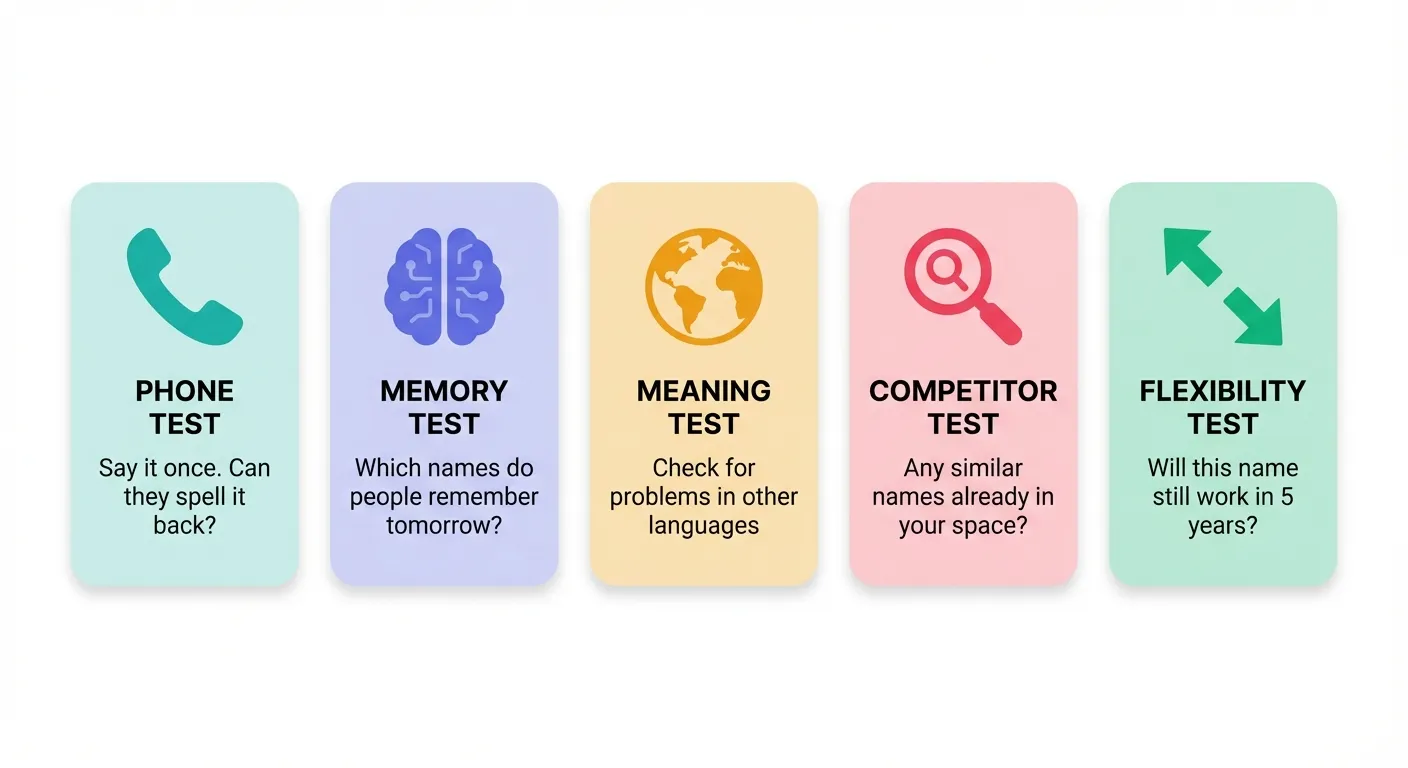
Once you have a shortlist, run each name through these filters:
The phone test - Call a friend and say the name once. Ask them to text it back to you. If they spell it wrong, reconsider.
The memory test - Mention 3-4 candidate names in conversation. The next day, ask which ones people remember. The survivors are your strongest options.
The meaning test - Search the name in multiple languages. Words that mean something embarrassing or negative in other languages can cause real problems as you scale.
The competitor test - Search the name and its close variations. If there's already a business with a confusingly similar name in your space, it's not worth the trademark risk.
The flexibility test - Imagine your business in five years. Does the name still work if you expand into adjacent markets? A name like "Amazon" scales infinitely. A name like "BookDepository" doesn't.
For a deeper framework on scoring domains across brand fit, verbal clarity, authority, SEO potential, and resale value, see our 5-minute brand audit guide.
Common Mistakes to Avoid
Even when aiming for brandable names, founders make predictable errors:
- Forcing cleverness. A pun that requires explanation isn't clever - it's confusing. If you have to say "get it?" after telling someone your name, keep looking.
- Misspelling for availability. Swapping letters to find an available domain (Lyft, Fiverr, Tumblr) requires a marketing budget most startups don't have. Spelled-as-expected names are almost always the better choice for early-stage companies.
- Ignoring the sound. Reading a name on screen isn't enough. Say it out loud, repeatedly. Names that look fine in writing can feel awkward when spoken.
- Naming for today's product. Your first product isn't your last. Choose a name that gives you room to grow, not one that describes a feature you might deprecate.
The Bottom Line
Keyword domains feel safe because they describe what you do. But that description becomes a cage - limiting your brand, your SEO, and your ability to be remembered.
Brandable names require more creative effort upfront. But they pay dividends in every interaction your business has: easier word-of-mouth, stronger search presence, higher trust, and a name that appreciates in value as your brand grows.
The techniques here - metaphors, invented words, unexpected real words, blends, and creative TLD combinations - give you concrete starting points. Generate lots of candidates, test them ruthlessly, and pick the one that passes every filter.
If you want to accelerate the process, URLGenie generates dozens of brandable names per session (not keyword mashups), scores them for memorability, brand fit, and risk, and checks real availability across multiple TLDs. It's the difference between staring at a blank page and having 50 scored options to evaluate in minutes.
Your domain name is the first thing people learn about your brand. Make it worth remembering.