
You have a name you love. It's catchy, it's relevant, it captures exactly what your business does. There's just one problem - the correctly spelled version is taken. So you do what Flickr, Lyft, and Tumblr did: drop a vowel, swap a letter, add a "z" where an "s" should be.
It feels clever. It looks distinctive. And according to a growing body of research, it's probably costing you customers.
The Misspelling Trend (And Who It Actually Worked For)
Deliberate misspelling took off in the mid-2000s. Flickr dropped the "e" from Flicker in 2004. Tumblr launched without the "e" in 2007. Lyft chose to spell "lift" with a "y" in 2012. These names became household brands, and a generation of founders took notice.
What most founders missed is context. These companies succeeded despite their misspellings, not because of them. They had something most startups don't:
- Massive marketing budgets to train millions of people on the "correct" spelling
- First-mover advantage in categories where they defined the space
- Years of repetition across billboards, app stores, and press coverage
When Flickr launched, they didn't compete with ten other photo-sharing platforms for search traffic. When Lyft grew, they spent hundreds of millions on advertising to burn "L-Y-F-T" into public memory. Your pre-seed startup with a $500 marketing budget doesn't have that luxury.
What the Research Actually Says
The assumption behind creative misspelling is that it makes your brand distinctive and memorable. Research from the Journal of Marketing tells a different story.
A team at the University of Notre Dame and Ohio State University ran eight experimental studies on consumer reactions to unconventionally spelled brand names. Their finding was blunt: consumers interpret creative misspellings as marketing gimmicks, which reduces perceived sincerity and decreases purchase intent.
The numbers from follow-up research are striking:
- Consumers showed 13.6% higher preference for "Clear" over "Klear"
- 19.5% decreased likelihood of downloading an app called "Daily Gainz" versus "Daily Gains"
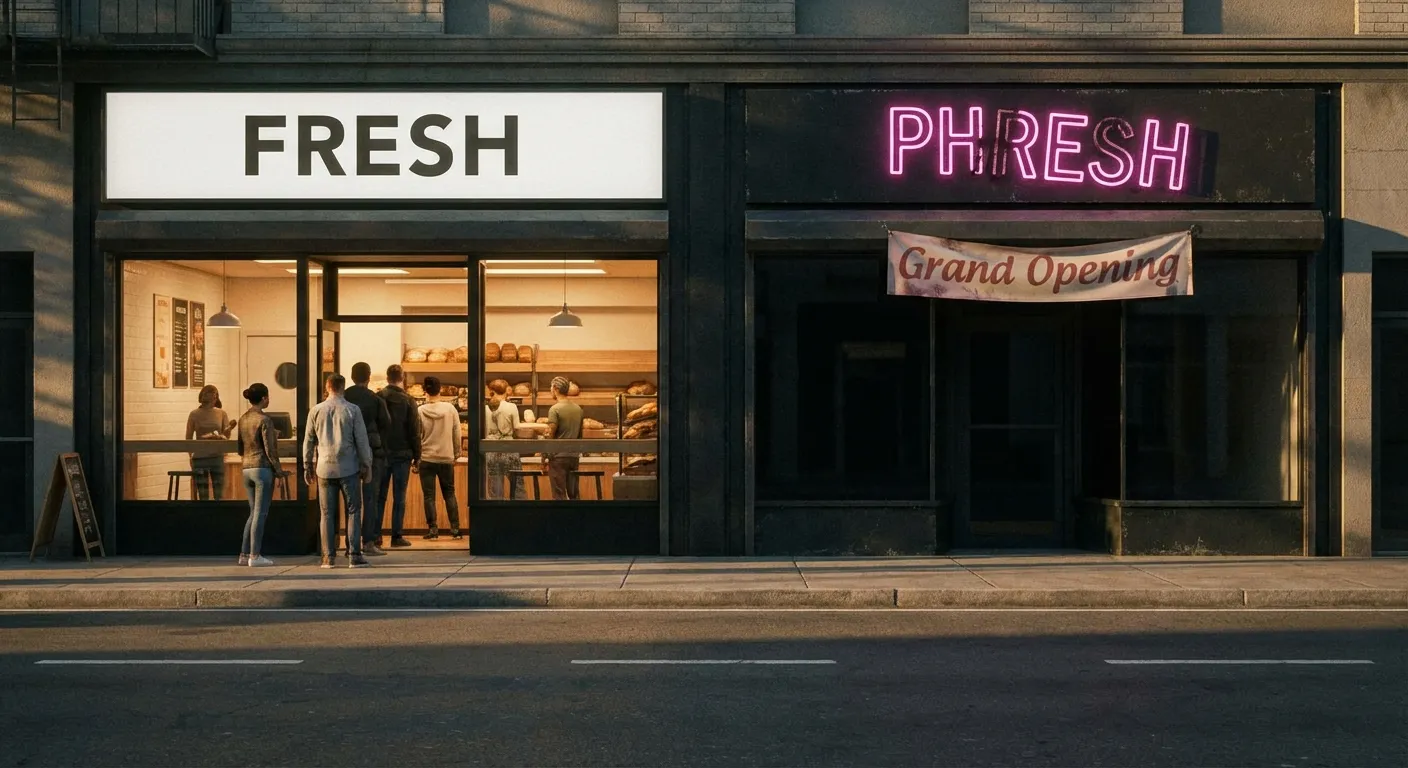
- 33.6% increased purchase likelihood for "Fresh" compared to "Phresh"
As the researchers put it, "unusual spellings are often seen as marketing tactics to appear trendy, which can come across as disingenuous." Your clever letter swap doesn't signal creativity to customers - it signals that you're trying too hard.
The Cognitive Load Problem
There's a deeper issue beyond perception: misspelled names are harder to process, and harder-to-process names generate less trust.
This is the principle of processing fluency. Research on cognitive fluency shows that information requiring less mental effort to process gets stored more efficiently in memory and generates stronger positive associations. When someone reads "Krispy Kreme," their brain has to do a tiny bit of extra work to reconcile the misspelling with the expected spelling. That friction is small - but it compounds across every customer interaction.
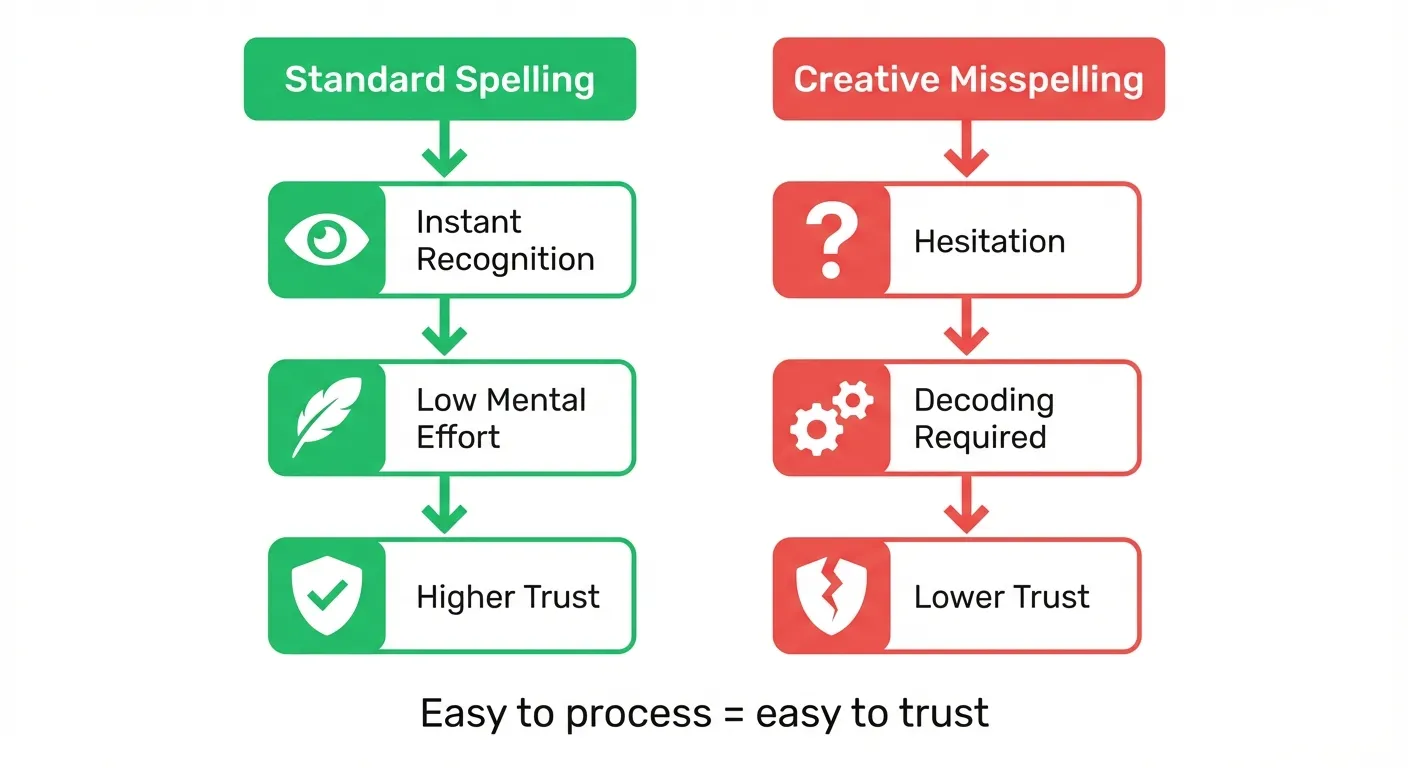
A study on cognitive load in brand names found that names exceeding two syllables or containing unconventional letter patterns perform worse for consumer recall. The brands that dominate their categories - Google, Nike, Stripe, Slack - are phonetically simple and spelled exactly as expected. There's no gap between what you hear and what you type.
This is directly related to what naming professionals call the "radio test" - can someone hear your name spoken aloud and type it correctly on the first try? Every misspelling is a failed radio test by design.
The Traffic Leak You Don't See
Here's the cost that never shows up in your analytics: the people who try to find you and can't.
According to NameSilo's analysis of domain typo data, roughly 14.5% of website traffic comes from users typing addresses directly into their browser. Of those, about 10% contain a typo. That means approximately 1.5% of your direct visitors may land on the wrong URL.
Now consider what happens when your name is already a misspelling. You're not just losing the people who misspell your misspelled name - you're also losing everyone who spells the word correctly. Someone hears about "Klear" and types "clear.com." Someone recommends "Lyft" and their friend searches for "Lift."
Major brands solve this by buying dozens of misspelled domain variants and redirecting them. Google owns Gogle.com, Gooogle.com, and scores of other variations. Amazon owns Amazn.com. When your name is already a misspelling, the number of defensive domains you need to register multiplies. That's a real, recurring cost.
For most startups, those defensive domains don't get purchased. The traffic just leaks.
The Abrdn Cautionary Tale
If you need a real-world case study in misspelling gone wrong, look no further than the investment firm formerly known as Aberdeen.
In 2021, the 200-year-old Scottish fund management company rebranded to "Abrdn" - dropping all vowels from their name. Their branding agency described it as symbolising "the free-flowing movement of money." The public described it differently. The rebrand faced years of widespread ridicule, became a running joke in financial press, and served as a constant distraction from the company's actual business.
In March 2025, the company reversed course entirely, returning to "Aberdeen Group." Their new CEO called it "removing distractions" and "a pragmatic decision." Four years and four name changes later, they ended up back where they started - minus the credibility cost of the ordeal.
Aberdeen had the resources to survive a naming misstep. They had decades of brand equity, institutional clients, and a multi-billion-pound business. A startup doesn't have that buffer.
When Misspelling Actually Works (Rare Cases)
To be fair, research does identify narrow conditions where misspellings succeed.
A 2025 study by marketing scholars Annika Abell and Leah Warfield Smith found that consumers accept misspellings when two conditions are met:
- The deviation is mild - simple compounds like "SoftSoap" performed as well as standard spellings
- The misspelling has conceptual relevance - it connects meaningfully to the product, the founder, or the visual brand
The study found that "Bloo Fog" (a tea brand riffing on "Oolong") worked because consumers understood the playful connection. "Blewe Fog" failed because the misspelling felt arbitrary.
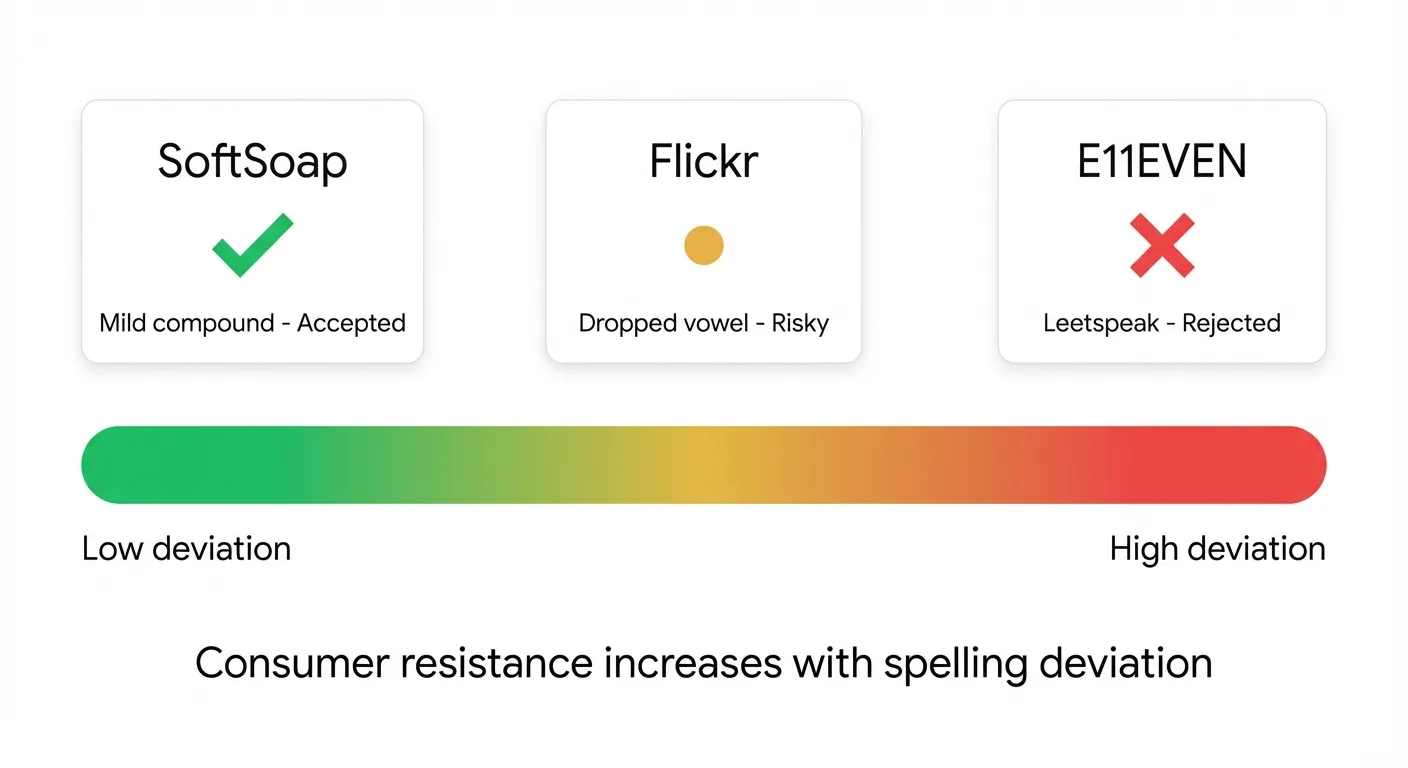
Similarly, the Journal of Consumer Research found that abridgments (like "Crumbl"), alphanumerics (like "Timbuk2"), and leetspeak (like "E11EVEN") consistently perform poorly because they require extra cognitive effort to decode.
The pattern is clear: the further you stray from standard spelling, the more consumer resistance you create.
What to Do Instead
If the correctly spelled version of your ideal name is taken, you have better options than creative misspelling:
- Try a different TLD. The name might be available as a .ai, .io, or .app. Industry-relevant extensions carry genuine credibility and avoid the spelling problem entirely.
- Use a metaphor. Stripe doesn't contain the word "payment." Notion doesn't contain "productivity." A name that evokes your value without literally describing it sidesteps availability problems.
- Blend words. Pinterest (pin + interest) and Instagram (instant + telegram) created new words rather than misspelling existing ones. Blends are distinctive and spelled as expected.
- Generate volume. The best name is rarely the first one you think of. Brainstorm 30-50 candidates and evaluate them systematically. As we covered in our 5-minute brand audit guide, scoring names across multiple metrics reveals strengths and weaknesses that intuition alone misses.
The Bottom Line
Deliberate misspelling feels like a creative shortcut. The data says it's usually a liability - reducing trust, increasing cognitive load, leaking traffic, and signalling inauthenticity to the very customers you're trying to impress.
The brands that made misspelling work had massive budgets and years to overcome the initial friction. If you're launching a new business or product, you almost certainly don't.
Spell it right. If the correctly spelled name is taken, find a better name - not a worse spelling.
URLGenie generates dozens of brandable name ideas per session, all scored for verbal clarity, brand fit, and risk. Every suggestion is designed to pass the radio test on the first try - no creative misspelling required.