
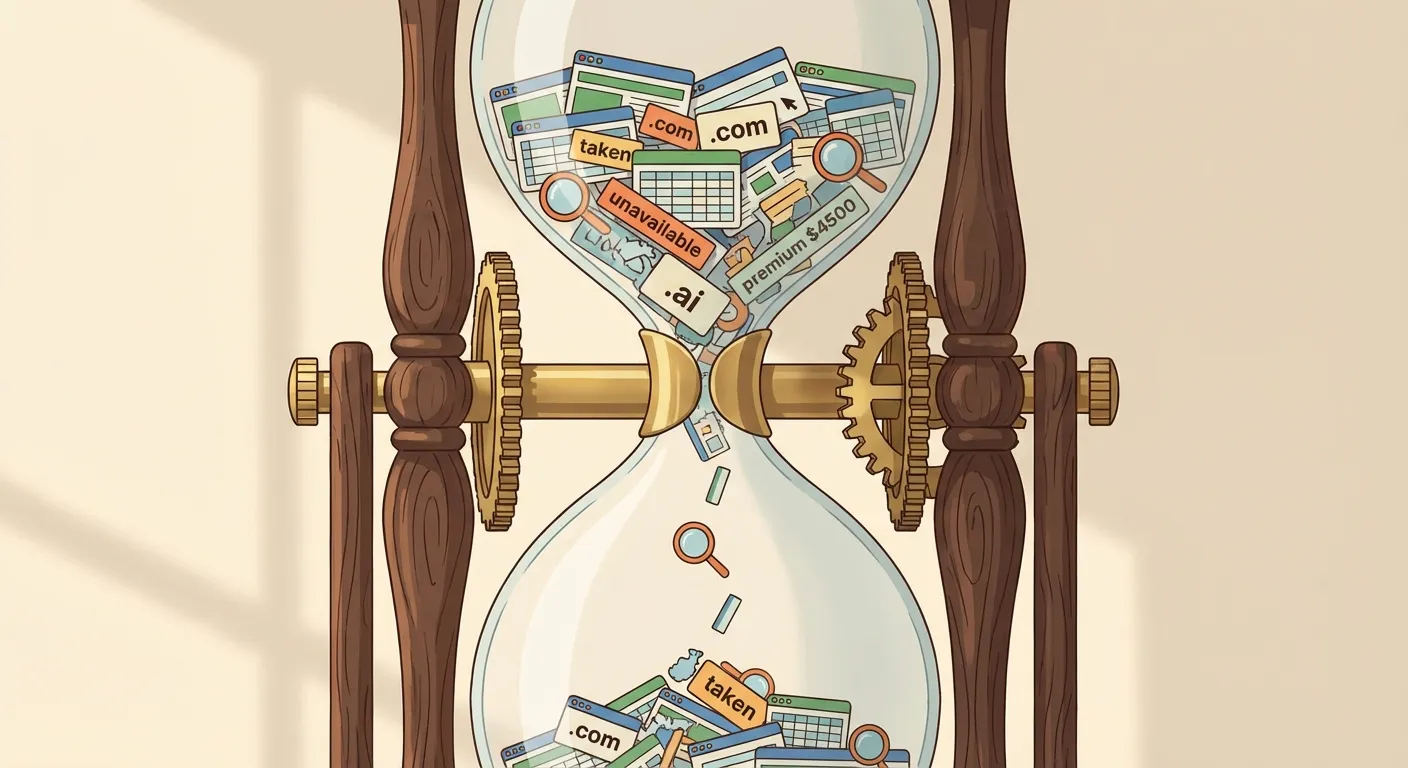
You've been at it for three hours. Seventeen browser tabs. A spreadsheet with 40 rows of domain names, each with a colour-coded availability status. You've checked .com, .ai, .io, and .app for every single one. You've Googled half of them for trademark conflicts. And you still don't know which name is actually good.
Most founders treat domain research as a quick task. It isn't. The real cost isn't the $12 registration fee at the end - it's everything you burn through getting there.
The Time Nobody Tracks
Let's break down what manual domain research actually involves. Not the idealised version - the real one.
For each name candidate, a thorough founder will:
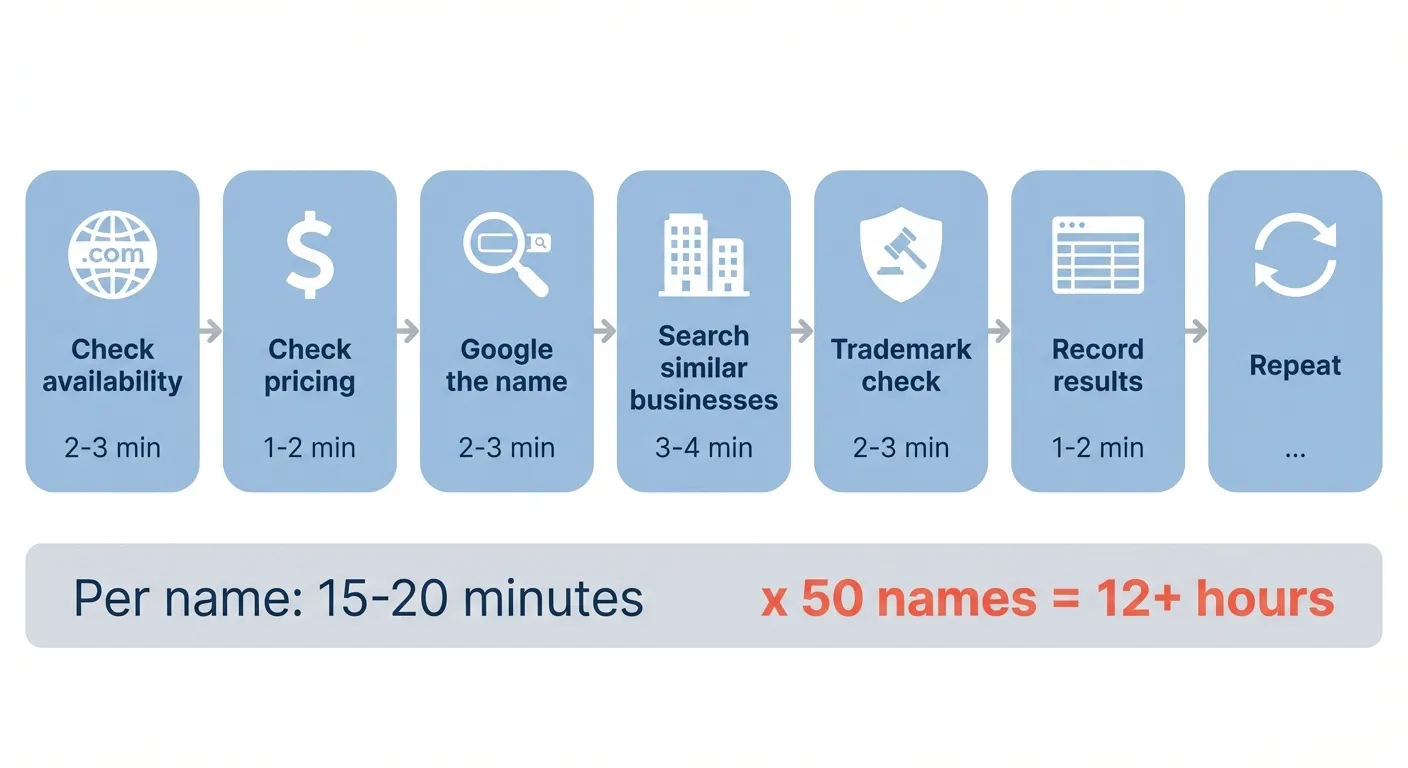
- Check availability across 3-5 TLDs (open registrar, type name, wait, record result)
- Check pricing for any that show as "premium" or aftermarket
- Google the name to see if anyone else is using it
- Search for similar businesses that could cause brand confusion
- Check basic trademark databases (USPTO, WIPO)
- Record everything in a spreadsheet for comparison
- Repeat for the next name
A conservative estimate: 15-20 minutes per name candidate, once you factor in tab-switching, loading times, and the inevitable rabbit holes ("wait, is that company still active?").
Most naming experts recommend generating at least 30-50 candidates before narrowing down. At 15 minutes each, that's 7.5 to 12.5 hours of pure research - not counting the brainstorming time to generate the names in the first place.
In practice, founders report spending days or even weeks. GBG Marketing's naming framework outlines a structured 5-day process - and that's considered fast. Many founders stretch the process across weeks of intermittent, unfocused effort, which is even less efficient than doing it in a concentrated block.
The Opportunity Cost Is the Real Price
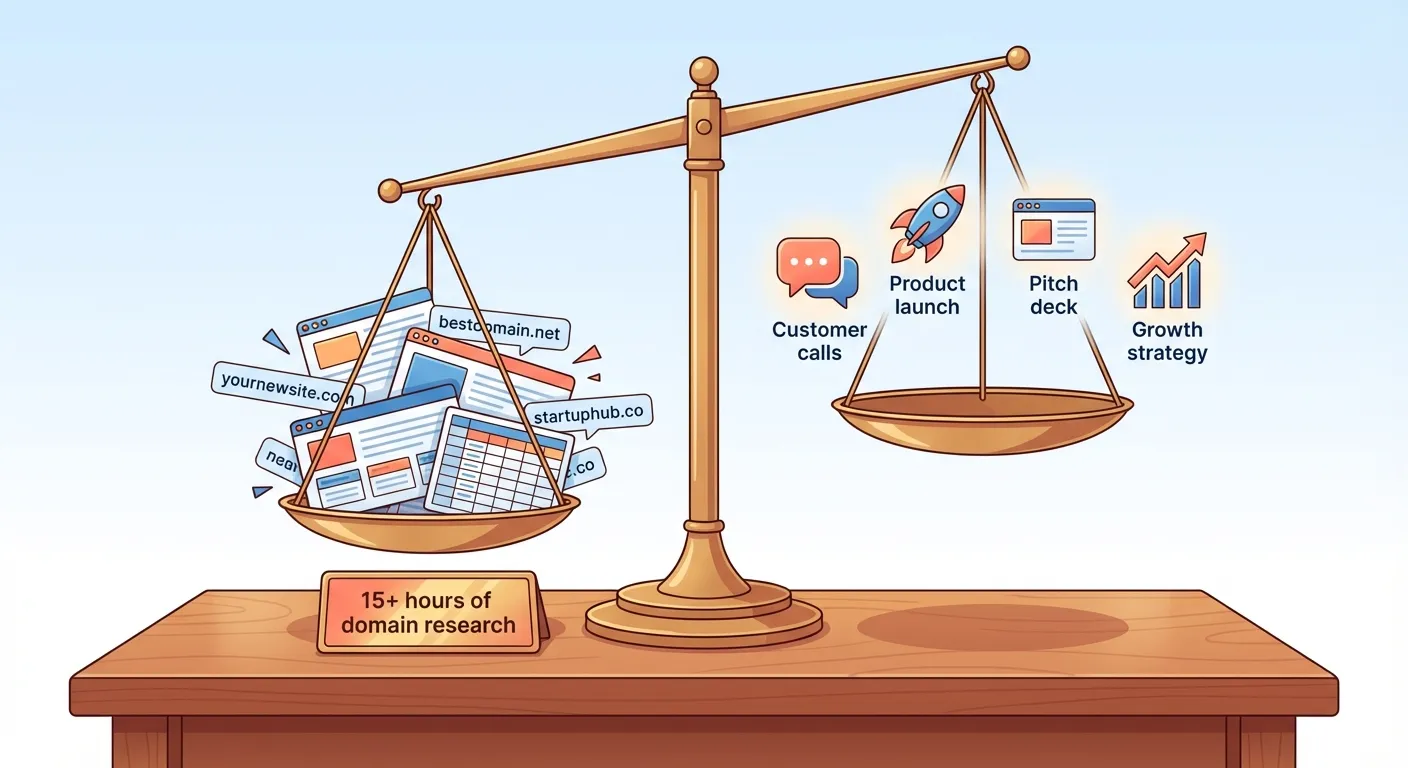
Time spent on domain research is time not spent on everything else your startup needs. And unlike most tasks, naming tends to happen at the worst possible moment - right before launch, when every hour matters.
Here's what 10-20 hours of founder time could look like spent differently:
- Customer discovery - 15-20 prospect interviews
- Product iteration - a full sprint of user feedback and fixes
- Go-to-market planning - landing page, launch strategy, first outreach
- Fundraising prep - a polished pitch deck and warm introductions
Research on delayed product releases consistently shows that time-to-market has compounding effects. Being a week late doesn't cost you one week of revenue - it costs you the customers who signed up with a competitor during that week, the word-of-mouth they generated, and the momentum you never built.
Every day your product sits unnamed is a day it isn't building brand recognition, collecting user feedback, or generating revenue. The naming task becomes a silent bottleneck that holds everything else hostage.
Decision Fatigue Makes You Choose Worse
Here's the part nobody talks about: the longer the naming process drags on, the worse your final decision gets.
Decision fatigue is the measurable decline in decision quality after prolonged decision-making. Your prefrontal cortex - the part of the brain handling planning and analysis - draws from a finite pool of cognitive resources. Every name you evaluate, every domain you check, every "is this one better than that one?" comparison drains that pool.
The result? Founders who spend days on naming often end up:
- Settling for the first "good enough" option because they're exhausted, not because it's genuinely the best choice
- Over-indexing on availability - picking the available name over the better name
- Abandoning the process entirely and launching with a placeholder they later regret
- Second-guessing their choice for months after, wasting more mental energy
Psychologist Barry Schwartz calls this the paradox of choice: more options don't lead to better decisions, they lead to paralysis. When your spreadsheet has 50 names with no clear framework for comparing them, every choice feels equally uncertain.
The Hidden Costs You Don't See on a Spreadsheet
Beyond time and mental energy, manual research carries costs that are easy to miss:
Inconsistent evaluation. You check the first ten names thoroughly, then start cutting corners by name thirty. Some get Googled, some don't. Some get trademark checks, some you skip because "it's probably fine." This inconsistency means your final shortlist is based on uneven data.
Missed opportunities. Manual brainstorming tends to explore a narrow range of ideas. You generate names that fit your existing mental model, missing creative options you'd never think of. The best name might be one you never considered because you ran out of energy before considering it.
False confidence. A domain being available feels like validation - "it must be good if nobody's taken it!" But as we explored in our piece on the "available domain" myth, availability tells you nothing about brand fit, verbal clarity, or competitive positioning. Many available names are available for a reason.
The rebrand risk. Rushing the decision under fatigue leads to names that don't hold up. A comprehensive rebrand for a small to medium business can cost upward of $150,000 and take over six months. Getting it reasonably right the first time is dramatically cheaper than fixing it later.
What a Structured Process Looks Like
The fix isn't spending more time on research. It's spending less time - but spending it better.
As I described in how I built my own naming tool, the breakthrough wasn't working harder at manual research. It was realising that a systematic process could compress days of work into minutes while actually producing better results.
A structured naming process should:
- Generate volume first - 50+ candidates, not 5, because great names often come from unexpected directions
- Check availability automatically - across multiple TLDs simultaneously, not one at a time
- Score against consistent criteria - the same metrics applied to every name, not gut feeling at varying energy levels
- Surface risks early - trademark conflicts and similar businesses flagged before you get attached to a name
- Compare systematically - ranked results, not colour-coded spreadsheet cells
The difference isn't just speed. It's that you make the decision with better data, more options, and a fresher mind. URLGenie was built to do exactly this - compress the research into minutes so you can spend your time on the decision, not the data gathering.
Stop Paying the Research Tax
The domain research tax is real: days of founder time, degraded decision quality, delayed launches, and occasionally a name you end up regretting. Most founders pay it without realising because naming feels like something you "just have to grind through."
You don't. The manual research spiral is a solved problem. Whether you use a systematic tool or simply time-box the process more aggressively, the goal is the same: get to a confident decision faster, with better data, and move on to the work that actually grows your business.
Your name matters. The process of finding it shouldn't consume you.