
Naming your SaaS is harder than ever. The best .com domains disappeared years ago, AI tools have automated domain squatting, and every clever portmanteau has been registered since 2003. Yet choosing the wrong name can doom your startup before you write a line of code.
The good news: naming trends have become clearer. Data from thousands of successful startups reveals patterns that work, TLDs that signal credibility, and traps that sink founders who don't see them coming.
The 2-3 Syllable Sweet Spot
Forget what you've heard about keeping names short at all costs. The data tells a more nuanced story.
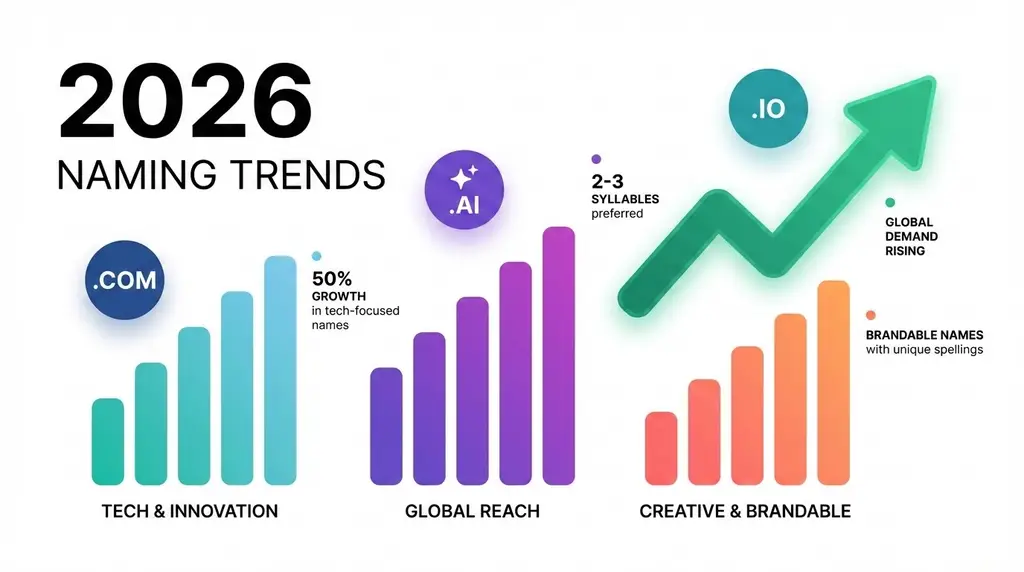
An analysis of 101 successful SaaS companies found that their names average 2.48 syllables, with over 75% using the "sweet spot" of two or three syllables. One-syllable names are memorable but nearly impossible to find available. Four or more syllables become forgettable.
Think about the SaaS names that stick:
- Two syllables: Slack, Notion, Figma, Canva, Stripe
- Three syllables: Asana, Airtable, Webflow, Monday
What matters more than syllable count is pronounceability. Can someone hear your name once and spell it correctly? This is the "radio test" — if a customer hears your brand mentioned on a podcast, can they type it into a browser without guessing?
Names that fail the radio test:
- Intentional misspellings (Lyft, Fiverr) — confusing for word-of-mouth
- Dropped vowels (Flickr, Tumblr) — worked a decade ago, feels dated now
- Obscure words — if customers need to Google the spelling, you've already lost them
The TLD Landscape Has Shifted
A comprehensive analysis of over 4,000 startups from Y Combinator and Techstars (2020–2025) reveals a major shift: nTLD usage has grown 50% in the past five years while legacy TLDs, including .com, have declined in new registrations.
This doesn't mean .com is dead. It means founders have more legitimate options.
.COM: Still the Gold Standard (When Available)
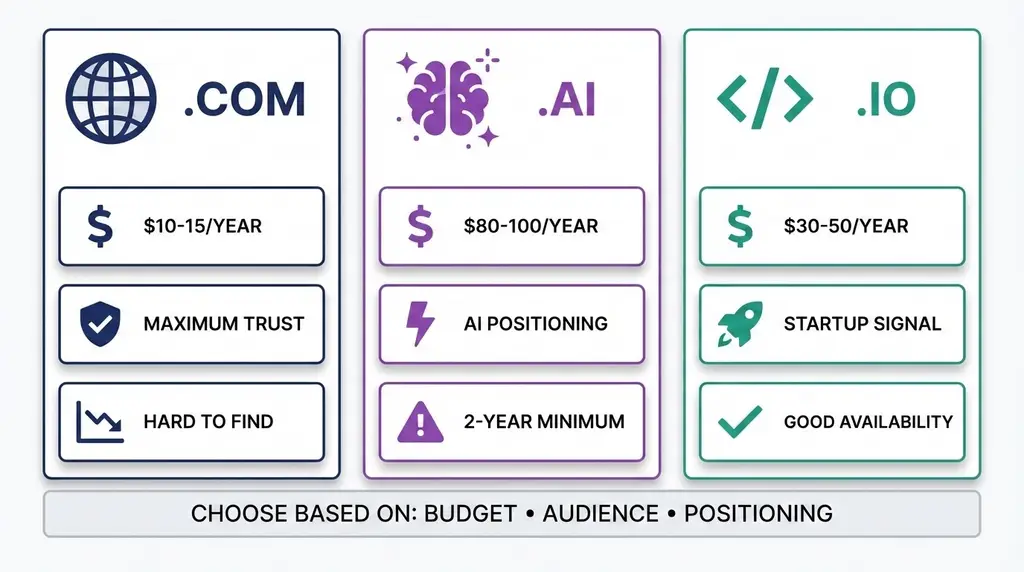
.com remains the default for trust and resale value. Afternic's 2024 data shows .com still dominates sales volume by a massive margin. For e-commerce, B2B enterprise sales, or any business where customer trust drives conversions, .com is worth the premium.
The reality check: Most good .com names are taken or priced in the thousands. If you're choosing between a forgettable .com and a memorable .ai, the memorable option often wins.
| TLD | Typical Cost | Best For | Trade-offs |
|---|---|---|---|
| .com | $10-15/year | Trust, enterprise, e-commerce | Low availability, high aftermarket prices |
| .ai | $80-100/year | AI-focused products | 2-year minimum registration, high renewal |
| .io | $30-50/year | Developer tools, startups | Technical audience signal |
| .co | $25-35/year | General startups | Sometimes confused with .com typos |
| .app | $15-20/year | Mobile apps, web apps | Requires HTTPS (not a bad thing) |
.AI: The Hot TLD (With Hidden Costs)
The .ai extension has exploded among AI startups for obvious reasons. It's a clear positioning signal: "We do AI." Tech giants including Google and Microsoft have embraced .ai domains, adding legitimacy.
But there are hidden costs:
- .ai domains require 2-year registration blocks, effectively doubling your upfront cost
- Renewal rates run $80-100/year compared to $10-15 for .com
- The extension is controlled by Anguilla (a tiny Caribbean island), creating some uncertainty about long-term policy
If your product is genuinely AI-first and you accept the higher ongoing costs, .ai makes sense. If you're using AI as a feature (not the core product), the premium may not be worth it.
.IO: The Developer Signal
The .io extension has become shorthand for "developer tools and startup culture." It's widely available, reasonably priced, and carries credibility in technical communities.
When .io works:
- Developer tools and APIs
- Technical B2B products
- Early-stage startups that might pivot
When to avoid .io:
- Consumer-facing products (average consumers don't recognize it)
- Enterprise sales where .com signals stability
Brandable Beats Keyword — Google Said It
In 2025, Google explicitly cautioned businesses against generic keyword domains. The era of "BestCRMSoftware.com" ranking through domain-name stuffing is over.
What works now:
- Brandable names that can own a category (think: Notion > NoteTakingApp.com)
- Coined words that sound natural (Stripe, Slack, Figma)
- Real words used unexpectedly (Monday, Linear, Pitch)
The SEO advantage of keyword domains has diminished to almost nothing. Meanwhile, brandable names are easier to remember, trademark, and build equity around.
This is where tools like URLGenie provide an advantage — generating brandable options rather than keyword mashups, then scoring them across multiple factors including verbal clarity and brand fit.
The Three Traps That Sink Startups
Trap 1: Trademark Conflicts
This is the naming mistake with the highest potential cost. Choosing a name that's "confusingly similar" to an existing business can result in:
- Cease and desist letters
- Forced rebranding (expensive and disorienting)
- Legal fees that drain your runway
The trap: Many founders check if the domain is available and assume they're clear. But domain availability has nothing to do with trademark availability.
The fix: Before committing to any name, search the USPTO trademark database, Google the exact name, and check for similar businesses in your category. Tools that include risk scanning - like URLGenie's background check feature - can flag obvious conflicts early.
Trap 2: The Pronunciation Failure
You've found a clever name. It looks great on paper. Then you say it out loud in a meeting and realize no one can spell it.
Common pronunciation failures:
- Unusual spellings: "Xero" — is it Zero? Ziro?
- Ambiguous sounds: "Calendly" — some say CAL-end-lee, others say ca-LEND-lee
- Silent letters: If you have to explain the spelling, the name is broken
The test: Tell 10 people your company name verbally. Ask them to write it down. If more than 2 get it wrong, reconsider.
Trap 3: The .AI Cost Surprise
Many founders grab a .ai domain at launch without checking renewal costs. Two years later, they discover they're paying 5-8x what a .com costs annually — every year, forever.
The math:
- .com renewal: ~$12/year = $120 over 10 years
- .ai renewal: ~$90/year = $900 over 10 years
For a bootstrapped startup, that $780 difference over a decade is meaningful. For a VC-backed company, it's trivial. Know which category you're in before committing.

A Framework for 2026 Naming Decisions
Based on current trends and data, here's a practical framework:
Step 1: Generate 50+ brandable options Don't settle on the first name that "feels right." Generate dozens of candidates using AI tools, brainstorming sessions, or naming frameworks. URLGenie can produce ~50 scored options per session.
Step 2: Filter by the radio test Eliminate any name you can't say out loud and expect someone to spell correctly. Be ruthless here.
Step 3: Check availability across TLDs Don't just check .com. See what's available across .ai, .io, .co, and specialty TLDs. Sometimes the perfect name is available on an extension that fits your brand.
Step 4: Run risk scans Check for trademark conflicts, confusingly similar businesses, and negative associations. This step saves you from expensive mistakes later.
Step 5: Score and compare Evaluate remaining candidates on brand fit, verbal clarity, authority, SEO potential, and resale value. Data-driven comparison beats gut feeling.
What's Actually Working in 2026
- Short brandable names (2-3 syllables) with clear pronunciation
- Strategic TLD selection based on audience and budget, not just .com defaulting
- Risk-aware naming that checks for conflicts before registration
- Iterative refinement — using multiple brainstorm sessions to narrow down, not committing to the first option
The founders who name successfully in 2026 aren't those with the biggest branding budgets. They're the ones who approach naming systematically: generate volume, filter ruthlessly, validate early, and commit with confidence.
The Bottom Line
Naming your SaaS in 2026 is a solvable problem. The data is clearer than ever about what works — brandable names in the 2-3 syllable range, TLDs matched to your audience and budget, and systematic risk checking before you commit.
The traps are equally clear: trademark conflicts that force expensive rebrands, pronunciation failures that kill word-of-mouth, and TLD costs that surprise bootstrapped founders.
Your domain name is your startup's first impression, your marketing foundation, and often a deciding factor in customer trust. Take the time to get it right — or use tools that compress weeks of work into minutes.
Ready to find your perfect domain? Try URLGenie — AI-powered naming with risk scanning, multi-TLD availability checks, and data-backed recommendations in under 5 minutes.