
You spent three months perfecting your startup name. You registered the domain, designed the logo, printed business cards, and launched your website. Then the email arrives: "Cease and Desist - Trademark Infringement."
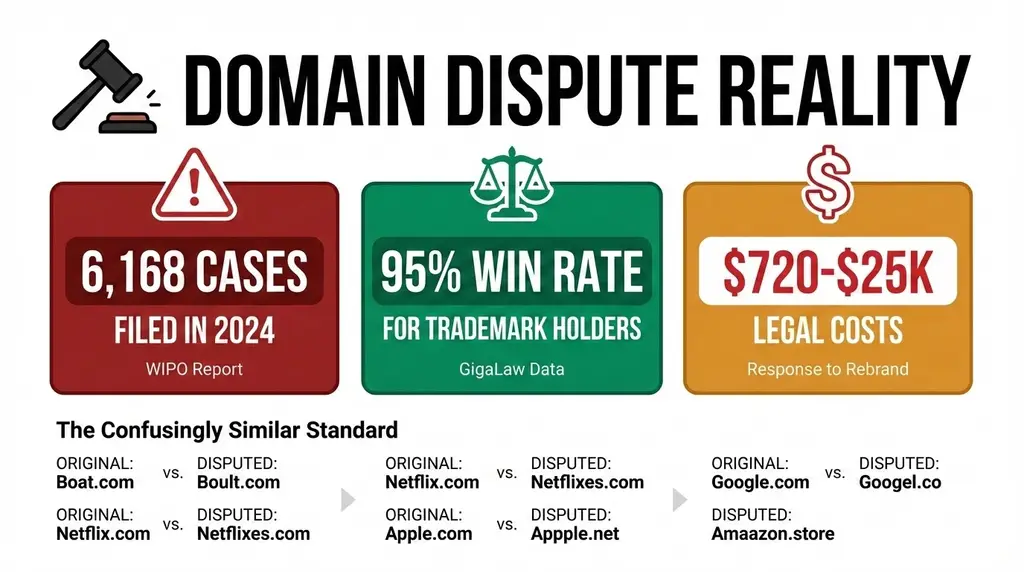
This nightmare is more common than most founders realize. In 2024 alone, trademark owners filed 6,168 domain dispute cases worldwide through WIPO's dispute resolution system. And according to GigaLaw's Domain Dispute Digest, trademark holders win approximately 95% of these cases.
The stakes are high. A cease and desist letter costs $720 to $2,500 just to receive and respond to. A forced rebrand? That's $3,000 to $25,000 or more. And that doesn't count the lost brand equity, customer confusion, or months of wasted marketing.
The good news is that most naming conflicts are preventable. You just need to know what to check before you commit to a name—and understand where the real risks hide.
The "Confusingly Similar" Standard Is Stricter Than You Think
Most founders assume they're safe if their exact name isn't taken. That's not how trademark law works.
Courts and arbitrators use a "likelihood of confusion" test. Two names don't need to be identical to create legal problems. They just need to be similar enough that customers might confuse one brand for another.
Real-world examples of "confusingly similar" conflicts:
- boAt vs. Boult - Indian audio brand Boult was forced to rebrand to GoBoult in 2025 after a years-long trademark dispute with rival boAt
- Sound-alike names in the same industry (think "CloudSync" vs. "CloudSynq")
- Different spellings of the same word ("Koffee" vs. "Coffee" for cafes)
- Names that share a distinctive prefix or suffix with established brands
The confusion test considers multiple factors: visual similarity, phonetic similarity, meaning similarity, and whether the goods or services overlap. You can lose even if your name is spelled differently—if it sounds the same when spoken, that's often enough.
What Happens When You Get It Wrong
Let's be clear about the consequences. Trademark conflicts don't resolve themselves, and ignoring a cease and desist letter makes everything worse.
Financial Costs
According to ContractsCounsel's marketplace data, responding to a trademark cease and desist costs an average of $720 through their platform—but $2,500 or more through traditional law firms. That's just for the initial response.
If the dispute escalates, costs multiply quickly. A full rebrand typically runs $3,000 to $25,000 for small businesses, including new branding, website updates, and replacing all branded materials.
Operational Disruption
A study by Frozenlemons found that 73% of entrepreneurs spend less than 5 hours on naming decisions—and many end up spending 4+ months fixing the resulting problems. That's four months when you're not focused on building your product or serving customers.
You'll lose the domain name you invested in, the SEO authority you built, and potentially the social media handles you've grown. Customers who bookmarked your site won't be able to find you.
Brand Equity Loss
Every day you operate under a name builds brand recognition. Switching names throws all that away. Your early adopters might not follow you to the new brand. Press coverage points to a dead domain. Backlinks become worthless.
The Due Diligence Checklist: What to Check Before You Commit
Here's the uncomfortable truth: most naming conflicts are caught with basic research. The founders who get sued typically skipped steps they should have taken on day one.
1. USPTO Trademark Database Search
Start with the United States Patent and Trademark Office (USPTO) database. It's free and searchable by anyone.
Search for your exact name, close variations, and phonetic matches. Don't just search the exact spelling—try common misspellings, abbreviations, and alternate spellings. Filter by your industry category (called "International Class") to see if anyone owns similar marks in your space.
Important: A clear USPTO search doesn't mean you're safe. Trademarks can exist through "common law" use even without federal registration. But a USPTO conflict is a clear stop sign.
2. State Trademark Registrations
Some businesses register trademarks at the state level instead of federally. Check your state's business entity database and trademark registry. If you plan to operate in multiple states, check those too.
State-registered marks have limited geographic protection, but they can still create problems if you're in the same region.
3. Web Search for Existing Businesses
This is where most founders stop—and where they should start digging deeper. Google your proposed name with industry keywords. Search for:
- "[Your name] + [your industry]"
- "[Your name] + company"
- "[Your name] + startup"
- Social media handles (@yourname on Twitter, Instagram, LinkedIn)
Look for active businesses, even if they're small or regional. An operating business with common-law trademark rights can challenge you even without a registered mark.
4. Domain Variations
Don't just check if YourName.com is available. Check:
- Other TLDs (.io, .ai, .co, .net)
- Common misspellings
- Plural vs. singular versions
- Hyphenated versions
If someone owns YourName.io and you take YourName.com, you might face customer confusion—or worse, they might accuse you of piggybacking on their brand.
5. Negative Brand Associations
Search your name for associations you don't want. Has it been used by a controversial company? Does it overlap with a scandal? Are there negative connotations in other languages or cultures?
This isn't strictly a legal risk, but it's a brand risk. You don't want to discover six months post-launch that your name is slang for something offensive in a market you plan to expand into.

When to Hire a Trademark Attorney
Some naming decisions require professional legal help. Here's when you should seriously consider hiring a trademark lawyer:
You should hire an attorney if:
- Your business will be backed by investors (they'll require clean IP)
- You're launching in a crowded category where trademark disputes are common
- Your search found similar names and you're not sure if they're too close
- You plan to grow quickly or expand internationally
- You're in a litigious industry (fashion, entertainment, consumer goods)
You probably don't need an attorney if:
- You're running a local service business with limited geographic scope
- Your name is clearly unique and your searches came up clean
- You're validating a side project before committing serious resources
A trademark attorney will conduct a comprehensive clearance search that goes far beyond what you can do yourself. They'll assess likelihood of confusion, search international databases, and provide a legal opinion on your risk level. Expect to pay $1,500 to $3,000 for a thorough clearance search and opinion letter.
That sounds expensive until you compare it to the cost of rebranding after launch.
How URLGenie Helps (And What It Doesn't Replace)
This is where tools like URLGenie come in—not as a replacement for legal clearance, but as an early warning system in your naming process.
When you run a naming session on URLGenie, the platform automatically runs background web searches on every generated name. It flags potential issues like:
- Confusingly similar businesses - existing companies with similar names that could create brand confusion
- Negative brand associations - names that overlap with controversial or problematic brands
- Background risk indicators - patterns that suggest potential trademark or reputation issues
What URLGenie is NOT: It's not a trademark search tool. It doesn't check the USPTO database or provide legal clearance. It won't tell you definitively that a name is legally safe to use.
What URLGenie IS: It's a risk scanner that helps you avoid wasting time on obviously problematic names. If you're choosing between 50 brainstormed names, URLGenie helps you filter out the ones with clear existing businesses or negative associations before you get attached to them.
Think of it like spell-check for brand risk. It catches common mistakes, but you still need an editor (in this case, a trademark lawyer) for the final review.
The Smart Naming Workflow
Here's the process that minimizes risk:
Step 1: Generate options - Brainstorm or use a tool like URLGenie to create 20-50 naming candidates
Step 2: Quick filtering - Run background checks to eliminate obvious conflicts (URLGenie does this automatically during the naming process)
Step 3: Narrow to top 5-10 - Pick your favorites from the names that passed initial screening
Step 4: Deep research - Manually search USPTO, Google, social media, and domain variations for your top picks
Step 5: Professional clearance - For your final 1-3 names, get a trademark attorney's clearance opinion (if your business warrants it)
Step 6: Register everything - Once cleared, immediately register the trademark, domain, and social handles
This workflow catches problems early when they're cheap to fix (picking a different name from your list costs nothing). It avoids the disaster scenario where you've already launched and built brand equity before discovering a conflict.
Common Mistakes Founders Make
Even founders who think they're being careful often make preventable errors:
Mistake 1: "I Googled it and nothing came up"
A basic Google search isn't enough. You need to search USPTO, state databases, and industry-specific directories. You need to search variations and misspellings. And you need to understand that "nothing came up" might just mean you didn't search thoroughly enough.
Mistake 2: "It's a different industry, so we're fine"
Trademark protection is broader than you think. Famous marks (think Apple, Amazon, Nike) get protection across all industries. Even for non-famous marks, courts consider whether customers might think there's a business relationship between the two companies.
Mistake 3: "We'll deal with it if someone complains"
This is gambling with your company's future. By the time someone complains, you've invested in the brand. You've built customer recognition. You've created SEO value. Walking away becomes exponentially more painful.
Mistake 4: "Our LLC is registered, so we own the name"
Registering a legal entity (LLC, corporation) with your state does NOT give you trademark rights. Entity registration and trademark registration are completely different systems. You can have an LLC named "XYZ Corp" and still infringe someone else's "XYZ" trademark.
Mistake 5: "The domain was available, so it's ours"
Domain availability and trademark clearance are different things. You can register a domain that infringes someone's trademark. The domain registrar doesn't check trademark law—they just check if the domain name string is available. That's why WIPO processed 6,168 domain dispute cases in 2024.
What "Safe Enough" Looks Like
No name is 100% risk-free. Even after a professional clearance search, there's a chance someone with common-law rights could emerge. But here's what "safe enough" typically looks like:
- Clean USPTO search in your industry class
- No active businesses with similar names in your category
- No exact-match domain owned by an operating business
- Social handles either available or clearly dormant
- No negative associations or problematic meanings
- Professional clearance opinion (for higher-risk launches)
If you hit all those checkboxes, you're in good shape. You've done your due diligence. You've minimized risk to an acceptable level.
Final Thoughts: Risk-Aware, Not Risk-Paralyzed
The goal isn't to be terrified of trademark law. The goal is to be informed and systematic.
Trademark disputes are serious, but they're also largely preventable. A few hours of research before you commit to a name can save you months of headaches and thousands in legal fees.
Use the checklist. Run the searches. For high-stakes launches, get a lawyer's opinion. And use tools that flag obvious problems early in the process, so you can focus your energy on the names most likely to be clear.
Your domain name is one of your most important early decisions as a founder. It's worth doing it right.
Not sure if your domain name idea is safe? URLGenie runs background checks on every generated name, flagging potential conflicts before you get attached. Generate 50 brandable options with built-in risk scanning in under 5 minutes. Try it free—no signup required.
Disclaimer: This article provides general information about trademark risk and domain naming. It is not legal advice. For legal guidance specific to your situation, consult a licensed trademark attorney. URLGenie provides background research and risk indicators, but does not conduct trademark searches or provide legal clearance.