
When you sell a product, your brand name is separate from you. When you sell a service, you are the brand. That changes everything about how you should name your domain.
Coaches, consultants, photographers, freelancers, and creators face a naming dilemma that product companies don't: do you name the business after yourself, or create a separate brand? And whichever you choose, how do you pick a domain that builds trust with clients who are hiring you, not a piece of software?
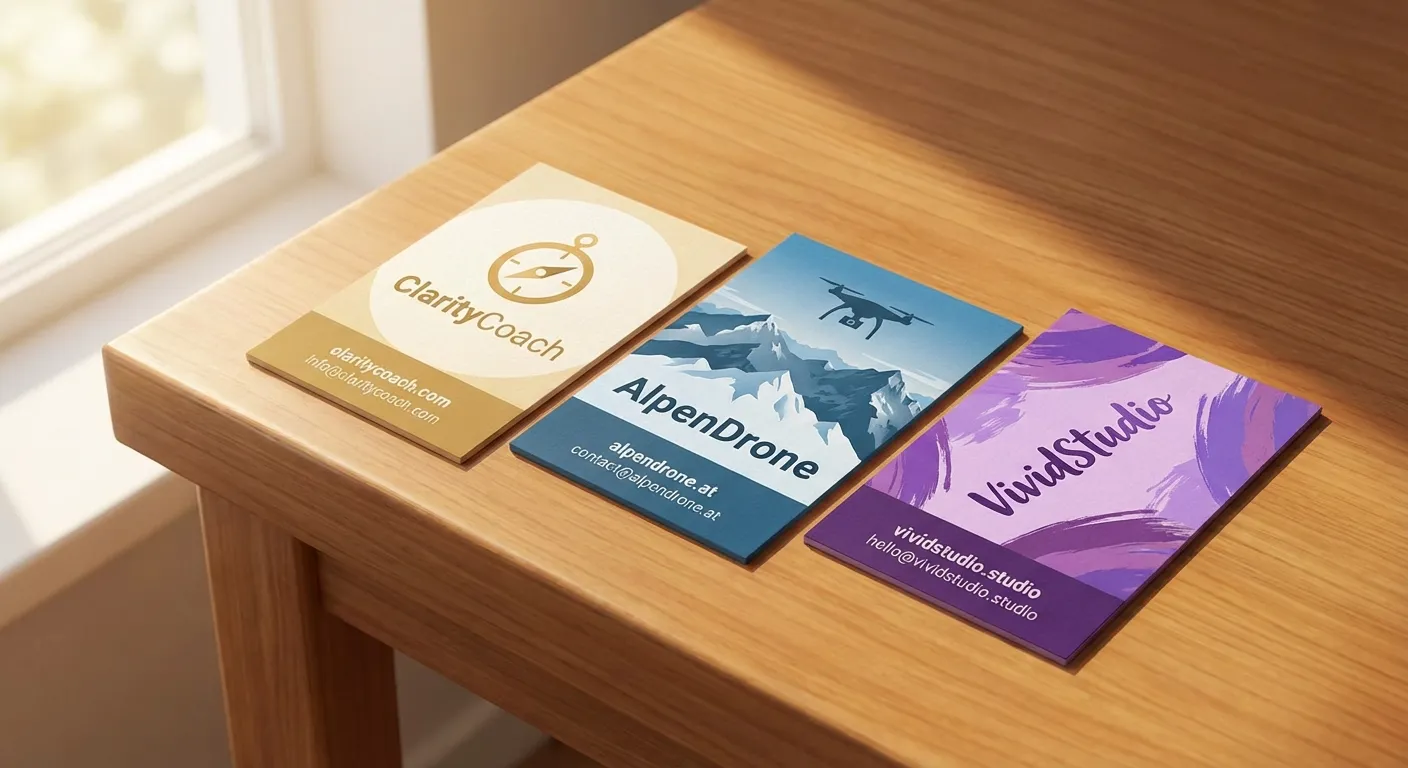
The Service Business Naming Dilemma
As we covered in our business naming guide, the core naming principles apply everywhere - verbal clarity, memorability, brand fit. But service businesses have unique tensions:
Personal name vs. business name:
- "JaneSmithCoaching.com" is clear and personal, but can't be sold or scaled beyond Jane
- "ClarityCoach.com" is brandable and scalable, but loses the personal connection clients want
- The hybrid approach - "SmithAndPartners.com" - tries to split the difference
Credibility vs. creativity:
- Service clients are buying trust. An overly creative or abstract name can feel risky for someone hiring a consultant or coach
- But a purely descriptive name ("BirminghamBusinessConsulting.com") looks generic and forgettable
Local vs. global reach:
- A fitness coach in Sydney might start local but build an online following globally
- A country-code TLD (.com.au) helps locally but limits perception internationally
Service Business Naming Strategies
Strategy 1: The Professional Brand
Build a name that's separate from you but professional enough to signal expertise.
When it works: Consultancies, agencies, B2B services that might scale or be sold
Examples: Accenture, McKinsey, Deloitte (all started as personal names, evolved into brands)
Domain approach: Prioritise .com or your country's ccTLD. Keep it short - two words maximum. Avoid industry jargon that dates quickly ("Digital," "Solutions," "Synergy").
Strategy 2: The Personal Brand
Use your own name as the foundation.
When it works: Coaches, speakers, solo consultants, creators whose personal reputation is the business
Domain approach: firstname-lastname.com is the cleanest format. If your name is common, consider adding your specialty: "JaneSmithWrites.com" or "SmithPhotography.com"
The key risk: If you ever want to sell the business or bring on partners, your personal name becomes a limitation. Plan for this if there's any chance you'll grow beyond solo.
Strategy 3: The Descriptive-Evocative Hybrid
A name that hints at what you do without being a literal description.
When it works: Most service businesses. It's the sweet spot between clarity and creativity.
Examples: "ClearView" for a consulting firm (suggests clarity), "Skyline" for drone photography (suggests aerial perspective), "Catalyst" for a business coach (suggests transformation)
Domain approach: These names tend to have good availability across TLDs because they're not generic category terms. Check .com first, then industry-relevant TLDs.
Case Study: Austrian Drone Photography Service
To show how this works in practice, here's a real naming session for a drone photography business in Austria. The service helps homeowners sell their properties by providing aerial photography and video.
The brief: A drone photography service targeting people selling houses in Austria. TLDs requested: .at (Austria's country code), .photography, .immobilien (German for "real estate")
URLGenie generated 50 candidates and the results revealed clear patterns about what works for international service businesses:
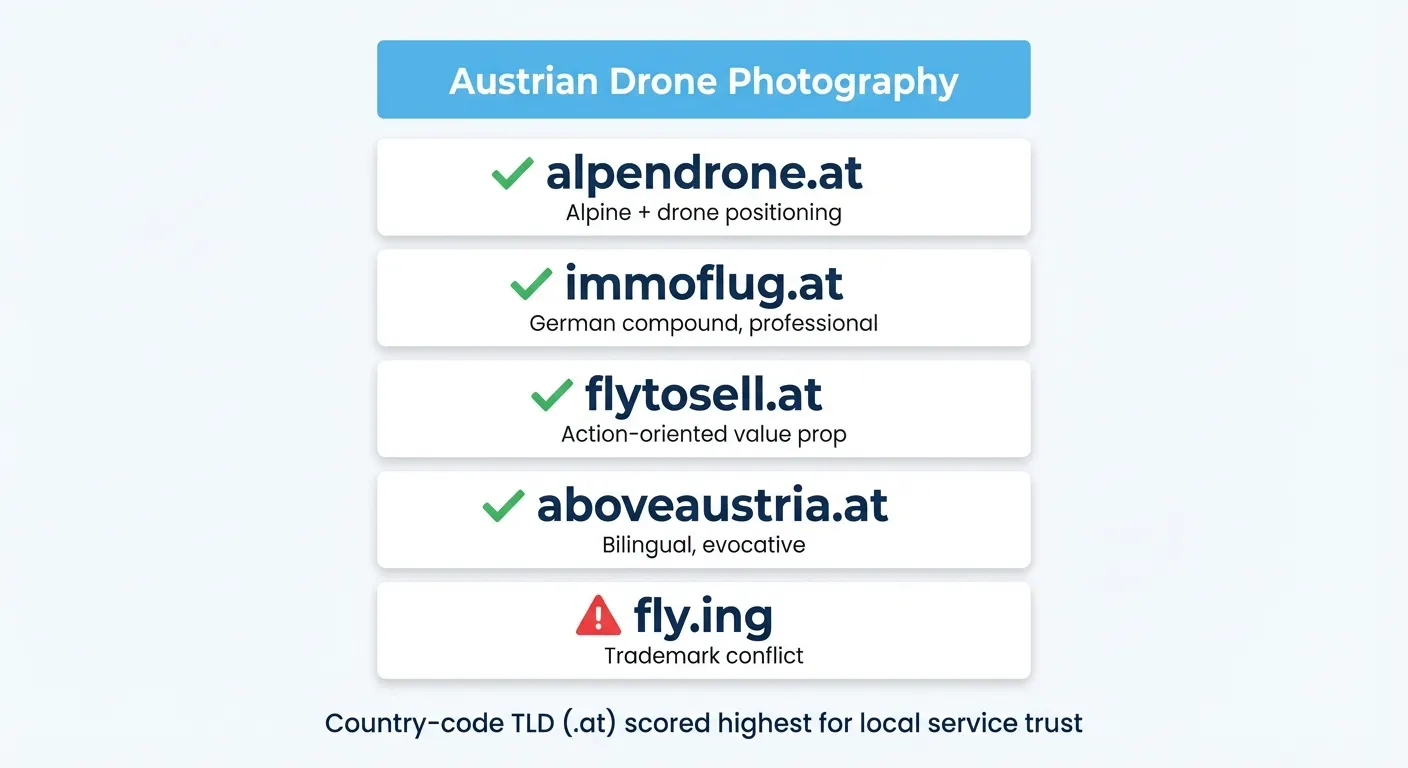
| Rank | Domain | .at Status | .photography Status | Notes |
|---|---|---|---|---|
| 1 | alpendrone.at | Available | N/A | Alpine + drone - perfect local positioning |
| 2 | immoflug.at | Available | N/A | "Immobilien" + "Flug" (flight) in German |
| 3 | flytosell.at | Available | N/A | Action-oriented, clear value proposition |
| 4 | aboveaustria.at | Available | N/A | Evocative, works in English and locally |
| 5 | aeroimmo.at | Available | N/A | Clean compound, professional feel |
Key insights from this session:
The .at TLD was the clear winner. For a service operating exclusively in Austria, the country-code TLD wasn't a compromise - it was the strongest positioning signal. "AlpenDrone.at" immediately communicates "Austrian drone service" without needing to explain it. The .at extension scored consistently higher on trust and authority than .photography or .immobilien for this market.
Bilingual naming worked. The Austrian market operates in German, but many property buyers are international. Names like "AboveAustria" and "FlyToSell" work in both English and German-speaking contexts. "ImmoFlug" uses German compounds that feel natural locally while remaining pronounceable for English speakers.
Domain hacks were flagged as problematic. Options like fly.ing, list.ing, and exhib.it looked clever but carried trademark risks. Fly.ing conflicted with an existing aerial photography service. The system recommended against all domain hacks for this use case because the target audience (homeowners selling property) expects professional, straightforward domains.
Long names were penalised. "AeroVisionAustria.at" and "AlpenblickDrone.at" scored well on brand fit but were flagged for length. When your domain appears on business cards, vehicle wraps, and email signatures, every character counts. The top-ranked names were all under 15 characters.
TLD Strategy for Service Businesses
Service businesses have more TLD options than they might think:
| TLD | Best For | Signal |
|---|---|---|
| .com | Global reach, US-based services | Universal trust |
| .co.uk / .com.au / .at | Country-specific services | "I operate here" |
| .photography | Photographers | Industry expertise |
| .consulting | Consultants, coaches | Professional credibility |
| .studio | Creative services, design | Creative identity |
| .coach | Life coaches, business coaches | Direct category signal |
The rule of thumb: If your clients are in one country, use that country's ccTLD. If you serve clients globally, use .com. Industry TLDs (.photography, .consulting) work as secondary registrations but shouldn't be your primary unless the .com is truly out of reach.
Common Service Business Naming Mistakes
1. Making it too long. "ComprehensiveBusinessStrategyConsulting.com" tells people what you do but nobody will type it twice. Aim for two words maximum.
2. Using jargon that dates. "Digital" felt modern in 2015. "Synergy" felt corporate in 2005. "AI-Powered" will feel generic by 2028. Choose words that won't age - a lesson from our piece on choosing a pivot-proof name.
3. Ignoring the email test. Your domain becomes your email address. "Jane@ClarityConsulting.com" looks professional. "Jane@Best-Business-Coach-London-UK.com" does not.
4. Skipping the trademark check. Service businesses are especially vulnerable to name conflicts because they operate in crowded, descriptive naming spaces. Two "Clarity Consulting" firms in the same market creates real legal risk.
5. Choosing a domain hack for a non-tech audience. Your coaching client doesn't know what .io means. Your real estate client won't type "pri.me" correctly. Match the TLD to your audience's technical comfort level.
Finding Your Service Business Name
Service naming is personal in a way that product naming isn't. Your name represents you to potential clients - your expertise, your professionalism, your trustworthiness. That's why a systematic approach matters even more than for product companies: you want to be confident in your name, not settling for whatever was available at midnight.
Generate options, score them against real criteria, check for conflicts, and choose with data. Whether you're a coach, a consultant, or a drone photographer in Austria, the process is the same - and URLGenie makes it fast enough to finish in an afternoon.
Your clients are Googling you right now. Make sure what they find is a name worth trusting.