
YouTube started as a video dating site called "Tune In Hook Up." Slack was an internal chat tool for a failed video game. Shopify began as an online snowboard shop. None of these companies ended up doing what they set out to do - and all of them had names flexible enough to survive the pivot.
Now imagine if YouTube had been called "VideoDateMatch.com." The pivot to general video sharing would have required a complete rebrand. The name would have been dead on arrival.

The Naming Trap Nobody Warns You About
When founders name their startups, they name what the company does right now. It's intuitive: you're building a meal delivery service, so you call it "QuickMealsNow." You're building an AI writing tool, so you call it "WriteWithAI."
The problem is that most startups pivot. The product you launch with is rarely the product that finds market fit. And when you pivot, a descriptive name becomes an anchor - not in a good way.
Descriptive names create three specific traps:
- Product trap: "QuickMealsNow" can't sell groceries, cooking classes, or kitchen equipment without confusing everyone
- Geographic trap: "LondonTechRepair" can't expand to Manchester without the name feeling wrong
- Category trap: "BestCRMSoftware" can't evolve into a broader business platform - it sounds like a keyword-mashed comparison site, not a brand
As we covered in our complete startup domain guide, the naming decision you make today echoes through every future business decision. A name that describes your current product is a bet that you'll never need to change direction.
Names That Survived Pivots (and Why)
The most valuable lesson comes from companies that pivoted successfully. Notice what their names have in common:
Amazon started selling books. Jeff Bezos chose "Amazon" - the world's largest river - because he wanted a name that suggested scale without specifying a product. Today Amazon sells everything. The name never held them back.
Slack emerged from a failed game called Glitch. "Slack" is an abstract word that has nothing to do with messaging, gaming, or any specific product. When the team pivoted to workplace communication, the name worked just as well.
Stripe was chosen by its founders specifically because it was short, neutral, and wouldn't box them into a single financial product. They started with online payments. Now they do banking, billing, fraud prevention, and more. The name never limited them.
Contrast these with names that couldn't survive:
- Pets.com - one of the dot-com era's most famous failures, trapped by a name that meant "pet supplies website" and nothing else
- MoviePass - a name that only worked for one product. When the model needed to evolve, the name was a cage
- Snowdevil - Shopify's original name for their snowboard store. It had to die for the platform to be born
The Flexibility Spectrum
Not all names need to be as abstract as "Stripe." There's a spectrum, and the right position depends on your risk tolerance for pivoting:
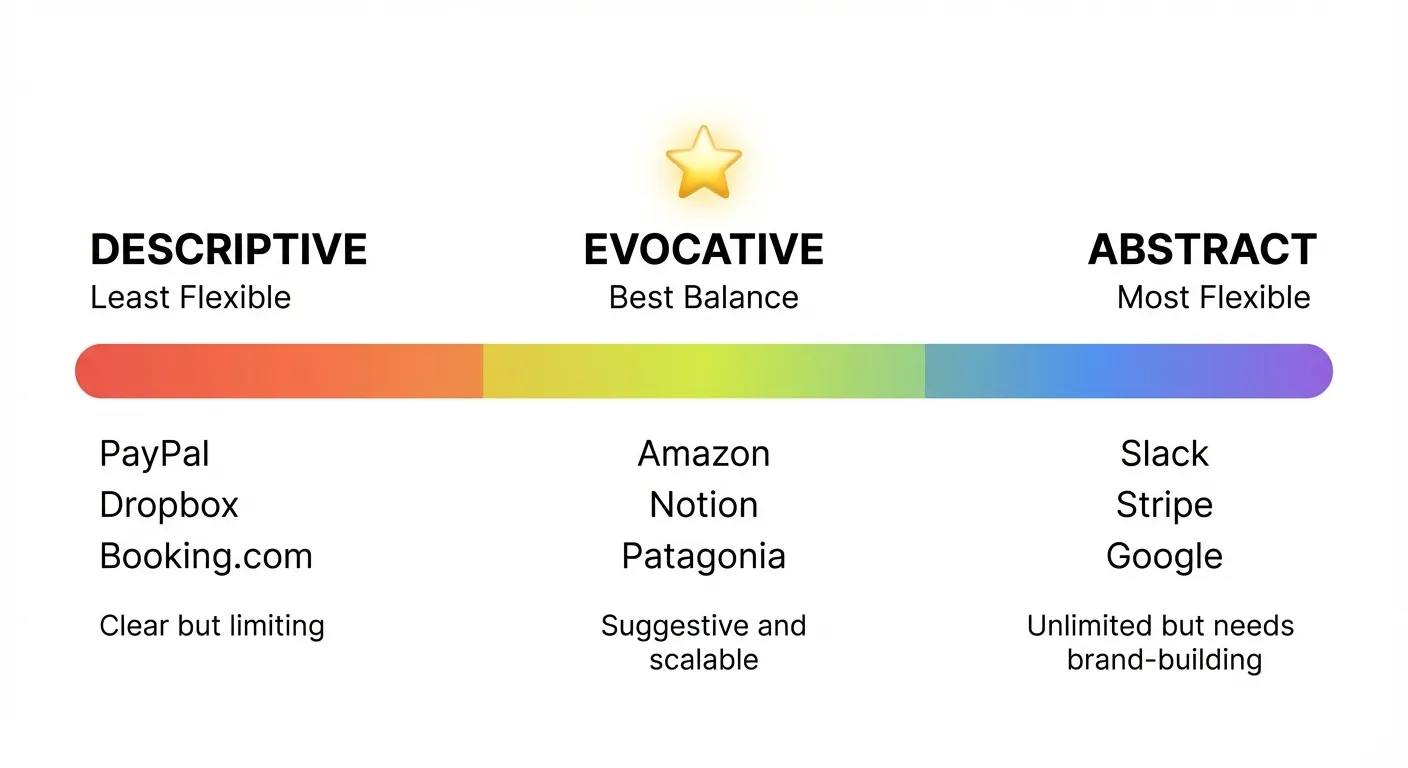
Descriptive (least flexible): PayPal, Dropbox, Booking.com
- Immediately clear what you do
- Great for SEO early on
- Traps you if you pivot
Evocative (moderately flexible): Patagonia, Amazon, Notion
- Suggests a quality or feeling without describing the product
- Works across related categories
- Best balance of clarity and flexibility
Abstract/Invented (most flexible): Slack, Stripe, Google
- Means nothing inherently - you define it
- Works for any pivot
- Requires more brand-building effort early on
The sweet spot for most startups is evocative - a name that hints at what you do without locking you in. "Notion" suggests ideas and organisation without specifying "note-taking app." When they expanded into databases, wikis, and project management, the name still fit perfectly.
How to Test If Your Name Is Pivot-Proof
Before committing to a name, run it through these three tests:
The "10x" test: If your company became ten times bigger and moved into adjacent markets, would the name still work? "FreshMealBox" fails this test. "Harvest" passes it.
The "explain it" test: When you say the name, do people immediately ask "so you do [specific thing]?" If yes, the name is too descriptive. You want people to ask "what do you do?" rather than assume they already know.
The "rebrand headline" test: Imagine the headline: "[Your Company] expands into [new category]." Does it read naturally, or does it sound absurd? "Amazon expands into cloud computing" works. "BooksOnline.com expands into cloud computing" doesn't.
The Counter-Argument: When Descriptive Names Win
To be fair, there are scenarios where a descriptive name is the right choice:
- You're building a lifestyle business that will never pivot (a local bakery, a niche consultancy)
- You're in a category where clarity is everything (Booking.com works precisely because nobody wonders what it does)
- You have zero marketing budget and need the name to do all the explaining
But even in these cases, lean toward the evocative end of descriptive. "Harvest" is better than "TimeTrackingForFreelancers.com" even if you never plan to pivot - because it's more memorable, more brandable, and more pleasant to say.
Choosing a Name That Grows With You
If you're naming a startup right now, here's the practical framework:
-
Start with what you want the brand to feel like, not what the product does. Words like "fast," "clear," "bold," "forge," or "arc" suggest qualities without limiting scope.
-
Check the 5-year horizon. Even if you're laser-focused today, where might the market take you? Choose a name that accommodates your most likely expansion paths.
-
Favour short, pronounceable words that can become verbs or nouns. "Slack me" works. "QuickTeamChatter me" doesn't.
-
Test against the three tests above before getting attached.
-
Score across multiple dimensions - not just "does this describe my product?" but brand fit, verbal clarity, authority, and long-term flexibility. URLGenie evaluates names across five metrics specifically to help founders see beyond the obvious.
Your startup's name is one of the few decisions that survives every pivot, every product change, and every strategic shift. Everything else can be rewritten - your codebase, your pricing, your market. But your name follows you everywhere. Choose one that won't hold you back when the inevitable pivot comes.