
Choosing a domain name for your startup isn't just about finding something available. It's a strategic decision that affects your brand perception, SEO performance, customer trust, and even your company's resale value.
The problem? Most founders approach domain naming backwards. They fall in love with a name, check if the .com is available, find it's taken or costs $50,000, and then spend weeks stuck in analysis paralysis or settling for a mediocre alternative.
This guide walks you through the complete domain selection process the right way: from strategic brainstorming through evaluation frameworks to availability checking and risk assessment. By the end, you'll have a systematic approach to finding and securing a domain name that actually works for your business.
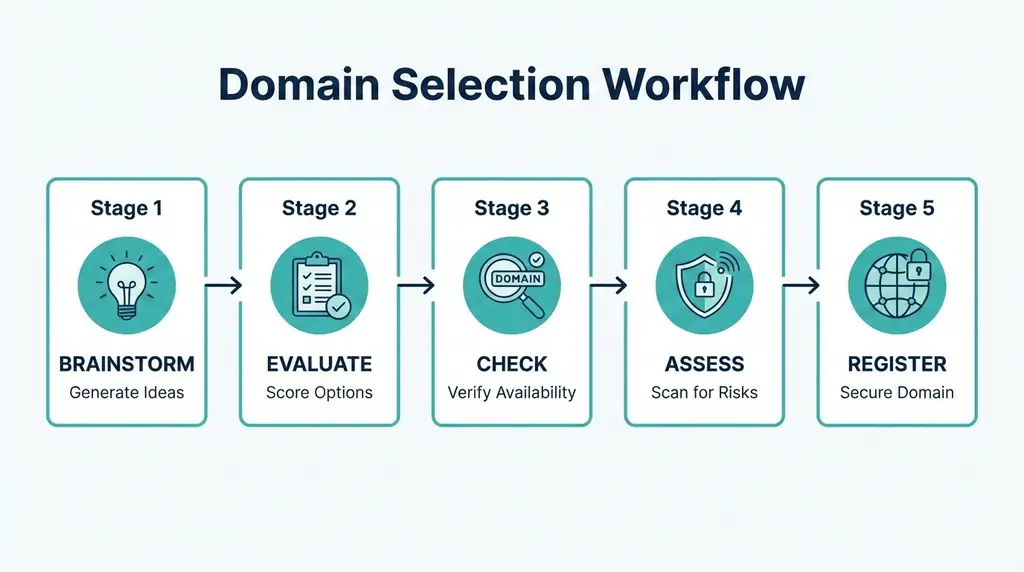
Table of Contents
- The State of Domain Names in 2026
- Stage 1: Strategic Brainstorming
- Stage 2: Evaluation Frameworks
- Stage 3: Availability Checking
- Stage 4: Risk Assessment
- Stage 5: Registration Strategy
- Bringing It All Together
- Common Mistakes to Avoid
- Final Thoughts
The State of Domain Names in 2026
Before diving into the process, let's acknowledge the reality: domain scarcity is worse than ever.
According to Hostinger's domain statistics report, there are now over 368 million registered domain names globally. The .com namespace, which still commands the highest trust and resale value, has been 90%+ saturated for years. Research from Wix shows that nTLD (new top-level domain) adoption has grown 50% since 2020 as startups seek alternatives to unavailable .com domains.
What this means for you: The days of finding a perfect, short .com domain for free are over. Your strategy needs to account for this reality from day one.
Stage 1: Strategic Brainstorming (Not Random Word Generation)
Most domain name generators fail because they approach naming as a keyword mashing exercise. Type in "cloud" and "software," get back "cloudsoft.com" (taken), "softcloud.com" (taken), and 50 more generic combinations (all taken).
Effective brainstorming starts with strategic constraints, not random combinations.
Define Your Naming Strategy First
Before generating a single name idea, document these strategic parameters:
1. Brand positioning
- Are you a premium offering or an accessible alternative?
- Do you need to sound enterprise-ready or founder-friendly?
- Should your name signal innovation or reliability?
2. Category conventions
- What naming patterns exist in your space? (e.g., AI tools often use .ai TLDs)
- Do you want to fit in or stand out?
- Are there overused suffixes to avoid? (e.g., "-ify", "-ly" fatigue in SaaS)
3. Verbal clarity requirements
- Will customers hear your name over phone calls or podcasts? (The "radio test")
- Do you need to work across multiple languages?
- Is spelling ambiguity acceptable? (Answer: usually no)
4. Future-proofing needs
- Could you pivot or expand into adjacent markets?
- Will the name constrain you if your product evolves?
- Does it work for both B2B and B2C if needed?
As First Round Review's naming guide emphasizes, completing a structured naming brief before brainstorming helps focus creative efforts and avoid wasted time on names that don't fit your strategic parameters.
Brainstorming Techniques That Actually Work
Technique 1: Evocative naming Instead of describing what you do, evoke the outcome or feeling. Stripe doesn't mention payments. Airtable doesn't mention databases. Notion doesn't mention documents.
Technique 2: Invented words Combine Latin or Greek roots, truncate words, or create entirely new terms. This increases availability odds dramatically. Examples: Zendesk (zen + desk), Shopify (shop + -ify), Twilio (invented).
Technique 3: Unexpected pairings Combine unrelated but memorable words. Snapchat, Dropbox, Netflix. The unexpected combination creates memorability.
Technique 4: Founder-filter method Generate 100+ ideas without self-editing, then filter ruthlessly against your strategic parameters. Volume first, quality second.

Tools can help here. URLGenie uses AI to generate brandable names based on your strategic brief, producing 50+ candidates per session instead of forcing manual brainstorming. This is especially valuable when you're naming your fifth feature or running multiple sessions to explore different naming directions.
Stage 2: Evaluation Frameworks (Data Over Gut Feel)
Once you have a list of 20-50 potential names, you need objective criteria to compare them. Relying on "gut feel" or team votes leads to endless debates and regret.
The Five Core Domain Evaluation Metrics
Building on naming principles from sources like First Round Review and analysis of successful startups, we use five metrics to predict domain name success:
1. Brand Fit & Clarity (Weight: 20%)
What it measures: How well does the name communicate your positioning and category?
Why it matters: Names with strong brand fit reduce marketing costs. Customers "get it" immediately instead of needing repeated explanation.
How to score:
- 10/10: Name immediately suggests category and positioning (Calendly for scheduling)
- 7-8/10: Name suggests adjacent category or requires minimal explanation
- 4-6/10: Abstract but memorable (Stripe, Asana)
- 1-3/10: Confusing or misleading
Red flag: Names that worked for one business model but not yours (don't copy patterns that don't fit)
2. Verbal Clarity (Weight: 20%)
What it measures: Can people spell it after hearing it once? Can they pronounce it when reading it?
Why it matters: Verbal clarity affects word-of-mouth marketing, podcast mentions, phone conversations, and direct URL traffic. Research from PrometAI found that names failing the "radio test" experienced 40% higher customer acquisition costs.
How to score:
- 10/10: Zero spelling ambiguity (Notion, Figma)
- 7-8/10: One obvious spelling (Calendly, Teachable)
- 4-6/10: Multiple plausible spellings (Fiverr vs Fiver, Lyft vs Lift)
- 1-3/10: Completely unclear pronunciation or spelling
The radio test: Say your name over a scratchy phone line. Can the listener type it correctly on the first try?
3. Authority & Trust (Weight: 20%)
What it measures: Does the name sound credible and professional?
Why it matters: Authority reduces customer skepticism and increases conversion rates, especially in B2B sales cycles.
How to score:
- 10/10: Enterprise-grade credibility (Salesforce, ServiceNow)
- 7-8/10: Professional but approachable (HubSpot, Intercom)
- 4-6/10: Casual but legitimate (Slack, Zoom)
- 1-3/10: Gimmicky or unprofessional
TLD impact matters here: A .com domain scores higher on authority than most alternatives. Industry research consistently shows that .com remains the most trusted extension, with users perceiving it as more credible than alternative TLDs.
4. SEO Potential (Weight: 20%)
What it measures: Will this domain help or hurt search rankings?
Why it matters: Better SEO equals lower customer acquisition costs over time.
How to score:
- 10/10: Brandable with relevant keywords (Mailchimp for email)
- 7-8/10: Strong brand signal, indirect SEO benefit
- 4-6/10: Abstract name requiring brand building (Asana)
- 1-3/10: Keyword stuffing or spammy patterns
Critical update for 2026: Google has confirmed that exact-match domains (EMDs) no longer provide ranking boosts and can trigger spam filters. Brandable domains now outrank keyword domains in most categories. Don't choose "cheapcarinsurance.com" style domains.
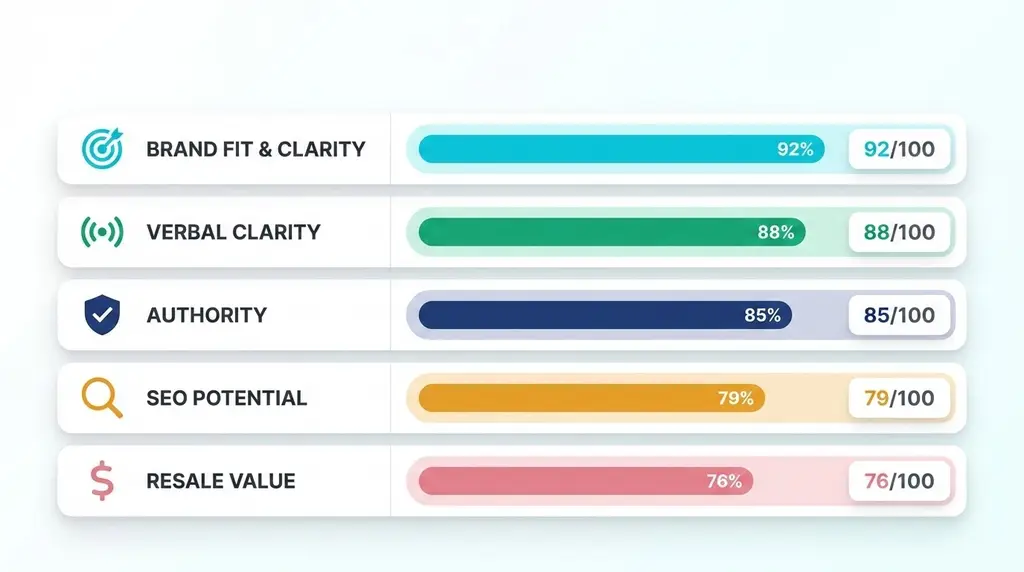
5. Resale Value (Weight: 20%)
What it measures: Could this domain be sold as a standalone asset?
Why it matters: Your domain is a financial asset. High resale value provides exit optionality and can be useful for fundraising (domains can be collateralized).
How to score:
- 10/10: Short, dictionary words or two-word combinations on .com
- 7-8/10: Invented but pronounceable brandables on premium TLDs
- 4-6/10: Longer phrases or industry-specific terms
- 1-3/10: Numbers, hyphens, or confusing spellings
Data from Deliberate Directions shows that 4-6 letter .com domains appreciate 12-18% annually, while most other domains depreciate.
Creating Your Evaluation Matrix
Build a spreadsheet with your candidate names in rows and these five metrics in columns. Score each name 1-10 on each metric (all weighted equally at 20%), then calculate a composite score.
This data-driven approach eliminates subjective arguing. When two founders disagree about names, the scores provide objective ground truth.
As we covered in our 5-minute brand audit guide, you can manually score domains this way or use tools like URLGenie that automate multi-factor scoring across 50+ candidates simultaneously.
Stage 3: Availability Checking (The Real Bottleneck)
Here's where most naming processes collapse: you've found great names, scored them objectively, and then discover all your top choices are taken or priced at $25,000+.
The Multi-TLD Availability Strategy
Stop checking only .com availability. In 2026, a comprehensive availability strategy requires checking multiple TLDs and understanding the trade-offs of each.
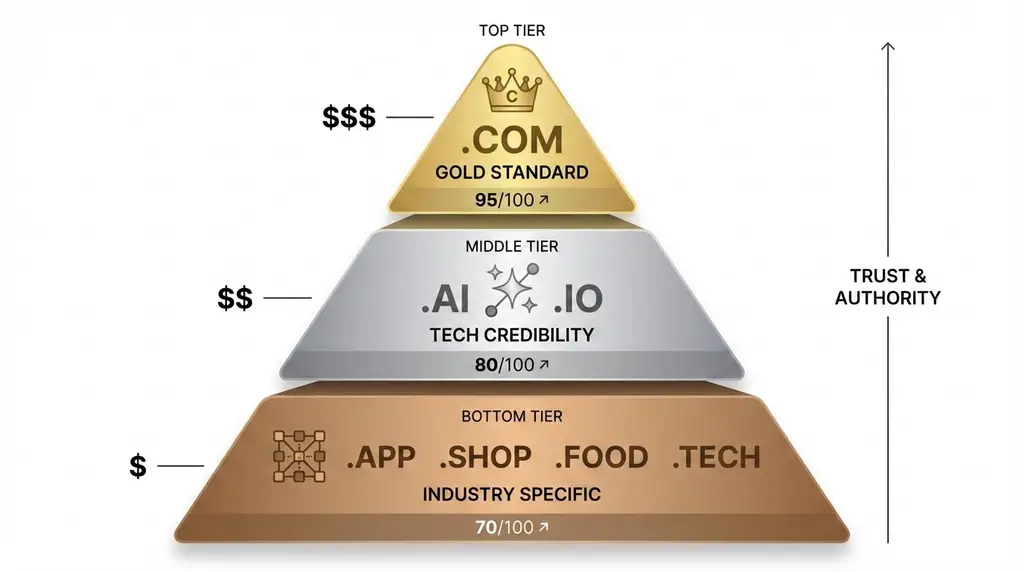
TLD Authority Hierarchy
Not all domain extensions are created equal. Here's the trust hierarchy based on research from Identity Digital and user perception studies:
Tier 1 (Highest Authority): .com
- Trust score: 95/100
- Best for: E-commerce, B2B SaaS, mainstream consumer apps
- Premium pricing: Very high
- Availability: Extremely limited
Tier 2 (Tech Credibility): .ai, .io, .app, .dev
- Trust score: 80/100
- Best for: AI tools, developer products, tech startups
- Premium pricing: Moderate to high
- Availability: Moderate (especially .ai)
Tier 3 (Industry Specific): .tech, .shop, .food, .design, .agency
- Trust score: 70/100
- Best for: Industry-specific businesses where TLD reinforces category
- Premium pricing: Low to moderate
- Availability: Generally high
When to choose each tier:
Choose .com when:
- You're building a mainstream consumer brand
- B2B enterprise sales are your primary model
- Email deliverability is critical (some spam filters still flag non-.com domains)
- Resale value matters for your exit strategy
Choose .ai/.io when:
- Your product is clearly tech-focused or developer-oriented
- The .com is taken but wildly overpriced ($50k+)
- Your target audience expects and trusts these TLDs (see our SaaS naming trends post)
Choose specialty TLDs when:
- The extension reinforces your category (cookieshop.food for a bakery)
- Your business is hyper-local or niche
- The .com alternative would require a completely different, inferior name
Research from Wix found that .ai domain registrations grew 300% from 2022-2025, with particularly strong adoption in the AI/ML startup ecosystem.
Availability Tools and Services
Manual checking (typing into registrar search boxes) is too slow when you have 50 candidates and 10 TLDs to check (that's 500 checks).
Bulk checking tools provide the efficiency you need:
- Most domain registrars offer bulk lookup (25-100 domains at once)
- Dedicated domain name generators check real-time availability across multiple TLDs and surface pricing for premium/aftermarket domains
- WHOIS databases can be queried programmatically if you're technical
Critical insight: "Available" doesn't always mean affordable. A domain might be technically unregistered but listed on aftermarket platforms for $10,000. Quality tools show both availability AND pricing so you're not wasting time on impossibly expensive options.
The Premium Domain Decision
At some point, you'll face the premium domain dilemma: your perfect name is available for $15,000 on the aftermarket.
Should you buy premium domains?
Run this calculation:
- Customer lifetime value (LTV): What's a customer worth to you?
- Conversion rate impact: Premium domains can increase trust by 15-30%, per research from Elementor
- Volume: How many customers do you need to acquire to justify the cost?
Example: If your LTV is $1,000, and a premium domain increases conversion by 20%, you need 75 additional customers to break even on a $15,000 domain. If you're driving 10,000 visitors per year, that's achievable.
Alternatives to premium purchases:
- Negotiate payment plans (many sellers accept installments)
- Consider whether the premium .com is genuinely better than a free .ai/.io alternative
- Wait and buy later (risky - the price might rise or it might be purchased by someone else)
Stage 4: Risk Assessment (Avoiding Costly Mistakes)
You've found an available domain that scores well. Before registering, you must check for risks that could derail your brand later.
The Three Critical Risk Checks
Risk 1: Confusingly Similar Businesses
The danger: Another company with a similar name in your category (or adjacent categories) could claim trademark infringement, force a rebrand, or sue for damages.
How to check:
- Google your proposed name + your category keywords
- Search USPTO trademark database (if US-based)
- Check Companies House (UK), equivalent registries internationally
- Search social media handles and app stores
Red flags:
- Exact match with existing company in related space
- Phonetically identical name to established brand
- Similar name in adjacent category that could claim confusion
Research from Dynadot shows that trademark holders win approximately 95% of domain dispute cases, with legal costs potentially reaching tens of thousands of dollars.
Our trademark risk guide goes deeper on this topic. The short version: don't skip this step. A few hours of research now prevents catastrophic costs later.
Risk 2: Negative Brand Associations
The danger: Your proposed name overlaps with controversial brands, adult content, or negative connotations you didn't anticipate.
How to check:
- Search your name + "scandal", "controversy", "lawsuit"
- Check if similar names exist in problematic industries
- Test pronunciation in multiple languages (some words are offensive in other contexts)
Example red flags from real startups:
- A food brand nearly chose a name that was slang for illegal drugs in UK English
- A SaaS tool picked a name phonetically identical to a bankrupt competitor
- An AI startup chose a name that matched a known crypto scam
Good naming tools automate these background checks, flagging known conflicts before you waste time on a problematic name.
Risk 3: Domain History Issues
The danger: A domain might be technically available but have a problematic history: spam associations, blacklist status, or previous use in scammy industries.
How to check:
- Use Wayback Machine to see previous site content
- Check domain against spam blacklists (MXToolbox, Spamhaus)
- Verify the domain wasn't recently dropped (could indicate issues)
Red flags:
- Previous use in adult content, gambling, or pharmaceuticals
- High spam score in reputation databases
- Recently expired after decades of registration (why did owner abandon it?)
As we discussed in our post on the domain availability myth, "available" and "safe to register" are not the same thing.
Stage 5: Registration Strategy (Securing Your Choice)
You've found a winner. Now you need to register it correctly.
Essential Registration Best Practices
1. Register multiple TLD variations Don't just register yourname.com. Also grab:
- Primary TLD (.com, .ai, etc.)
- Common misspellings (.co, alternate spellings)
- Geographic variations (.co.uk if relevant)
- Defensive registrations (.net, .org to prevent competitor squatting)
Budget: $50-150 for a defensive portfolio is cheap insurance.
2. Enable privacy protection WHOIS privacy masks your personal contact information from public databases. This prevents:
- Spam targeting domain owners
- Phishing attempts
- Competitors discovering your projects early
Most registrars include privacy for free or $10-15/year. Always enable it.
3. Use 2FA and strong passwords Domain hijacking is real. Use two-factor authentication on your registrar account and a unique, strong password. Store credentials in a password manager.
4. Set auto-renewal with backup payment methods Losing your domain due to an expired credit card is a preventable tragedy. Set auto-renewal and add a backup payment method.
5. Consider domain escrow for premium purchases If you're buying a $10,000+ domain, use escrow services (Escrow.com, Sedo.com) to protect both parties. Never wire money directly to a seller.
Timeline and Documentation
Register immediately. Domain prices can change overnight, and someone else might register your choice while you deliberate.
Document your selection rationale in a brief memo: why this name, what scores it received, what alternatives you considered. This helps future stakeholders understand the decision and prevents regret-driven second-guessing six months later.
Bringing It All Together: Your Domain Selection Workflow
Here's the complete process condensed into an actionable checklist:
Week 1: Strategic Brainstorming
- Define brand positioning and naming strategy
- Generate 50-100 name candidates using multiple techniques
- Shortlist top 20-30 based on initial gut check
Week 1-2: Evaluation
- Build evaluation matrix with 5 core metrics
- Score all candidates objectively
- Identify top 10 candidates by composite score
Week 2: Availability & Risk
- Check availability across 5-10 TLDs for top candidates
- Note pricing for premium domains
- Run risk checks: similar businesses, negative associations, domain history
- Eliminate any risky candidates
Week 2: Decision & Registration
- Select final choice based on scores + availability + risk profile
- Get stakeholder sign-off if needed
- Register domain + defensive variations immediately
- Enable privacy protection and security features
- Document decision rationale
Reality check: This workflow assumes you're doing everything manually. URLGenie compresses weeks 1-2 into a 5-minute automated process: it generates candidates, scores them across all five metrics, checks real availability, and runs background risk checks simultaneously. The workflow is the same, but the execution is vastly faster.
Common Mistakes to Avoid
After analyzing hundreds of startup naming decisions, these mistakes appear repeatedly:
Mistake 1: Falling in love with unavailable names Don't emotionally invest in a name before checking availability. Generate a large pool and let availability inform your shortlist, not dictate your regrets.
Mistake 2: Overvaluing novelty Clever wordplay and quirky spellings feel fun initially but create long-term friction. Prioritize clarity over creativity.
Mistake 3: Ignoring the radio test If people can't spell your name after hearing it, you lose word-of-mouth marketing and direct traffic. Test names verbally before committing.
Mistake 4: Skipping trademark searches Trademark conflicts can force expensive rebrands. Spend a few hours on research now to avoid $100,000 problems later.
Mistake 5: Choosing TLDs based solely on availability Don't pick .xyz or .info just because it's cheap and available. TLD credibility affects trust and conversion rates.
Mistake 6: Waiting too long to register Domains are cheap ($10-20/year). Register your shortlist immediately to avoid losing choices while you deliberate.
Mistake 7: Not securing variations Register common misspellings and alternate TLDs. Competitors or squatters will grab them otherwise.
Final Thoughts: Your Domain Is an Asset, Not an Afterthought
Your domain name is one of the most important decisions you'll make as a founder. It affects brand perception, customer trust, marketing costs, SEO performance, and eventual exit value.
The good news: With a systematic approach, you can find a great domain name without the endless frustration most founders experience. Define strategy first, generate volume, evaluate objectively, check thoroughly, and register immediately.
The time investment: Doing this manually takes 20-40 hours across 1-2 weeks. Using automated tools compresses this to minutes per naming session, letting you run multiple iterations quickly or name multiple projects efficiently.
The outcome: A domain name you're confident in, that scores well across all critical metrics, that's actually available within budget, and that won't cause legal problems down the road.
That's the domain selection process you need for 2026. Now go find your perfect domain.