
Most founders think of a domain name as a cost - something you pay $12 a year to keep the lights on. But the aftermarket tells a different story. In 2025 alone, over 190,000 domain sales totalling $304 million were recorded on NameBio. That same year, ai.com sold for $70 million, icon.com for $12 million, and commerce.com for $2.2 million.
Your domain isn't just an address. It's a financial asset that can appreciate or depreciate depending on the choices you make today. The question is: are you picking names that build value, or ones that will be worth nothing if you ever need to sell?
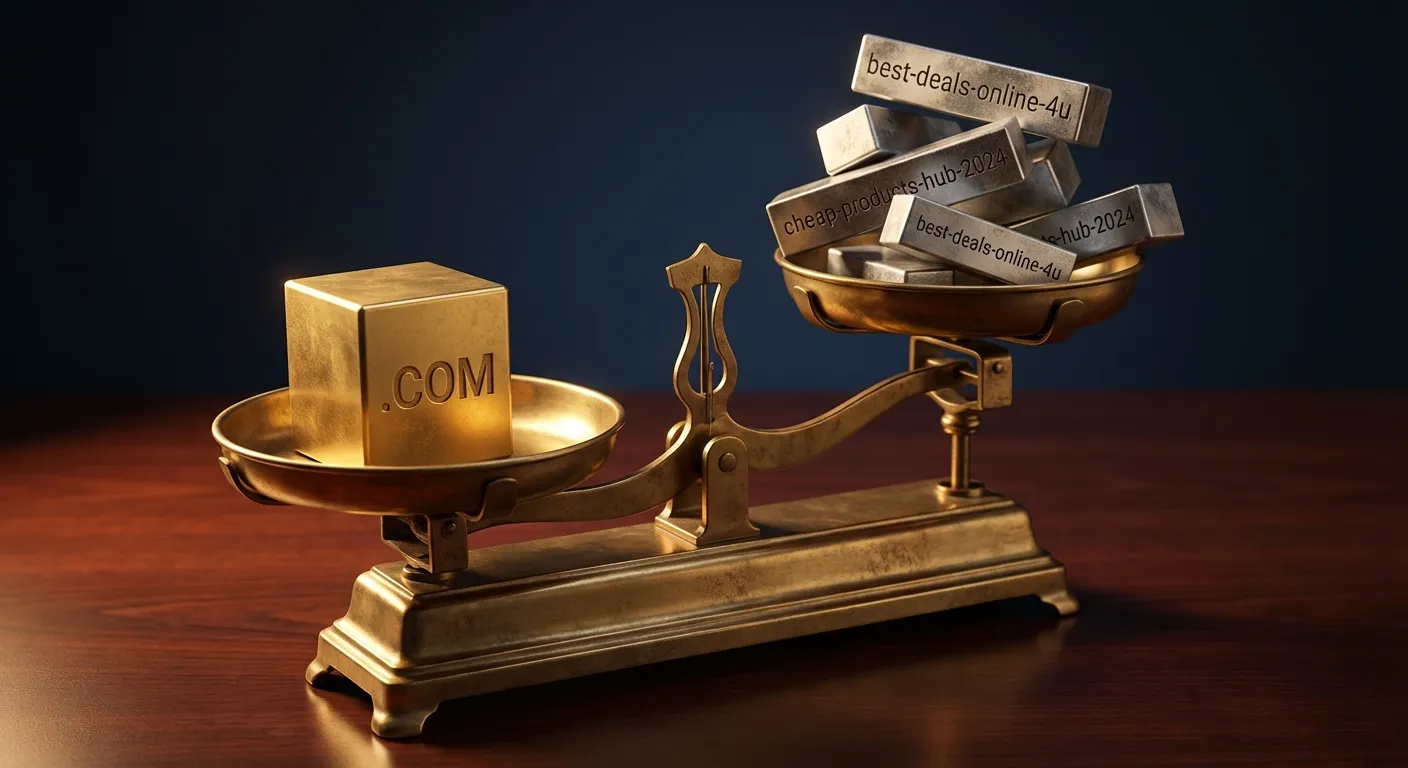
What Makes a Domain Worth Money?
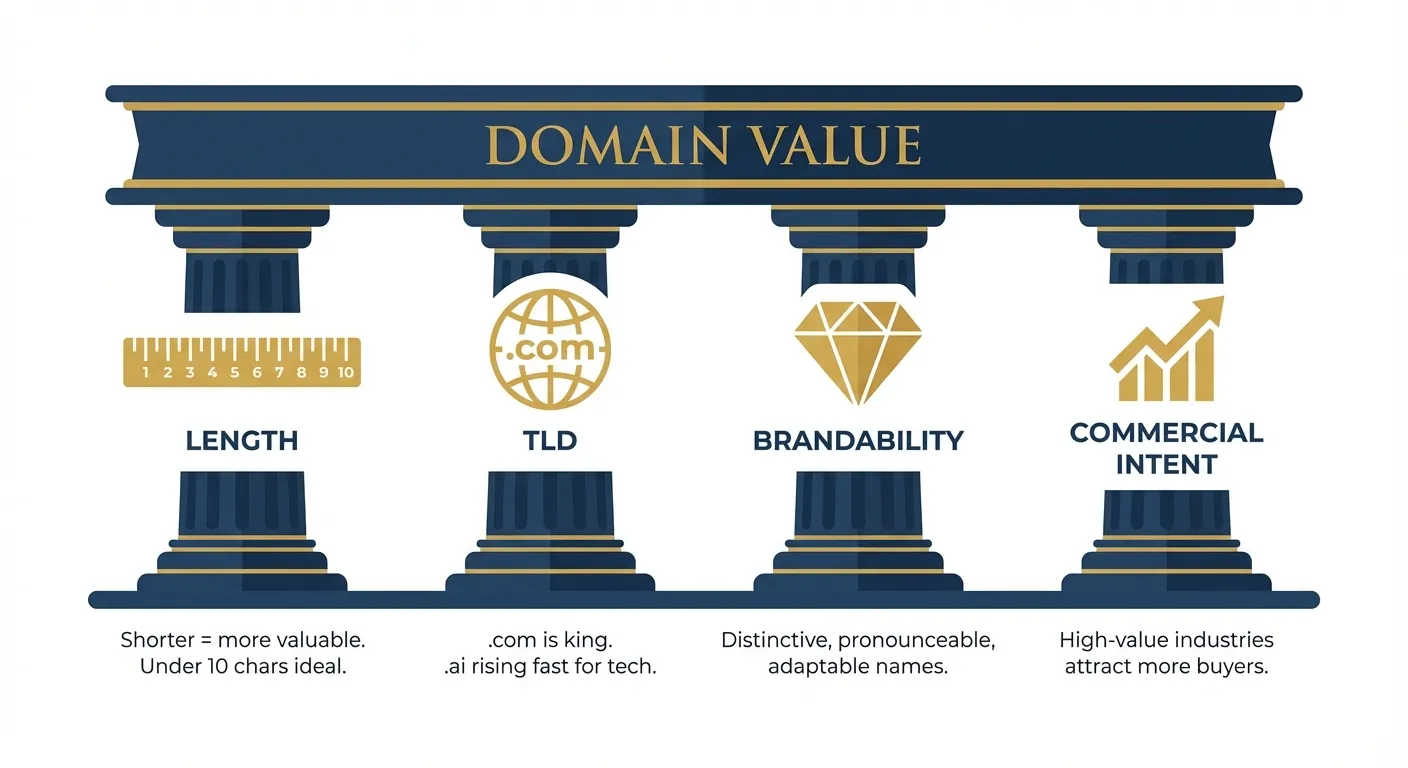
Domain valuation isn't guesswork - it follows predictable patterns. Professional investors and appraisers consistently evaluate four core factors when pricing a domain. Understanding these factors helps you pick names that hold value from day one.
Length
Shorter domains command dramatically higher prices. Every additional character reduces resale value. Two-letter .com domains regularly sell for six figures regardless of what the letters mean - gx.com sold for $1.2 million and zh.com for $1 million in 2025. One-word dictionary .com domains are the gold standard of domain investing.
The sweet spot for most founders is 6-10 characters. Short enough to be memorable and valuable, but long enough that you can actually find something available. Once you push past 15 characters, resale value drops sharply.
TLD (Top-Level Domain)
The extension matters enormously for resale value. Here's the hierarchy based on recent market data:
- .com - Commands the highest premiums by far. Nine of the top ten sales in 2025 were .com domains.
- .ai - The fastest-growing premium TLD. Projected to reach 6 million registrations by early 2025, with strong demand from the AI industry driving prices up.
- .io, .app, .xyz - Solid value in tech niches. viral.app sold for $100,000 and super.xyz for $287,607 in 2025.
- Niche TLDs (.food, .shop, .store) - Limited resale market. These work for branding but rarely appreciate as investments.
If resale value matters to you, .com is still king. But .ai is increasingly competitive for technology businesses.
Brandability
Generic keyword domains used to dominate the aftermarket. But the market has shifted. Today, brandable names often outperform keyword-stuffed alternatives because they're more versatile.
A domain like "stripe.com" has value in any context - payments, fashion, design. A domain like "fastpaymentprocessing.com" only works for one narrow use case, which shrinks the buyer pool dramatically.
As we covered in our guide to choosing brandable domain names, the most valuable names share three traits: they're distinctive, pronounceable, and adaptable across different business contexts.
Commercial Intent
Domains connected to high-value industries naturally command higher prices. Finance, insurance, real estate, and technology domains consistently top the sales charts. CarInsurance.com famously sold for $49.7 million - the highest publicly reported domain sale ever.
You don't need a domain worth millions. But picking a name in a category with genuine commercial demand means there will always be potential buyers if you need to sell.
The Depreciation Traps
Just as certain choices build value, others actively destroy it. These are the most common ways founders accidentally pick domains that will never be worth anything on the resale market.
Hyphens and Numbers
Domains with hyphens or random numbers almost never resell. They fail the verbal clarity test - try telling someone your website is "best-ai-tools-4-you.com" over the phone. Investors avoid them entirely, and end-users find them confusing.
Trend-Dependent Names
Names built around a fleeting trend lose value fast. If your domain only makes sense in the context of 2026's hottest buzzword, it's a depreciating asset. The strongest domains work across market cycles.
Obscure TLDs
While niche TLDs can work for branding, they're almost invisible on the resale market. As NameSilo's valuation guide notes, obscure new gTLDs consistently rank as "low value" compared to established extensions. If you're thinking about long-term asset value, stick to recognised extensions.
Overly Specific Names
A name like "BostonDogWalkingService.com" describes exactly one business in exactly one city. That precision is great for local SEO, but it means your buyer pool is essentially one person. Category-flexible names hold value better because more buyers can use them.
How to Score a Domain's Investment Potential
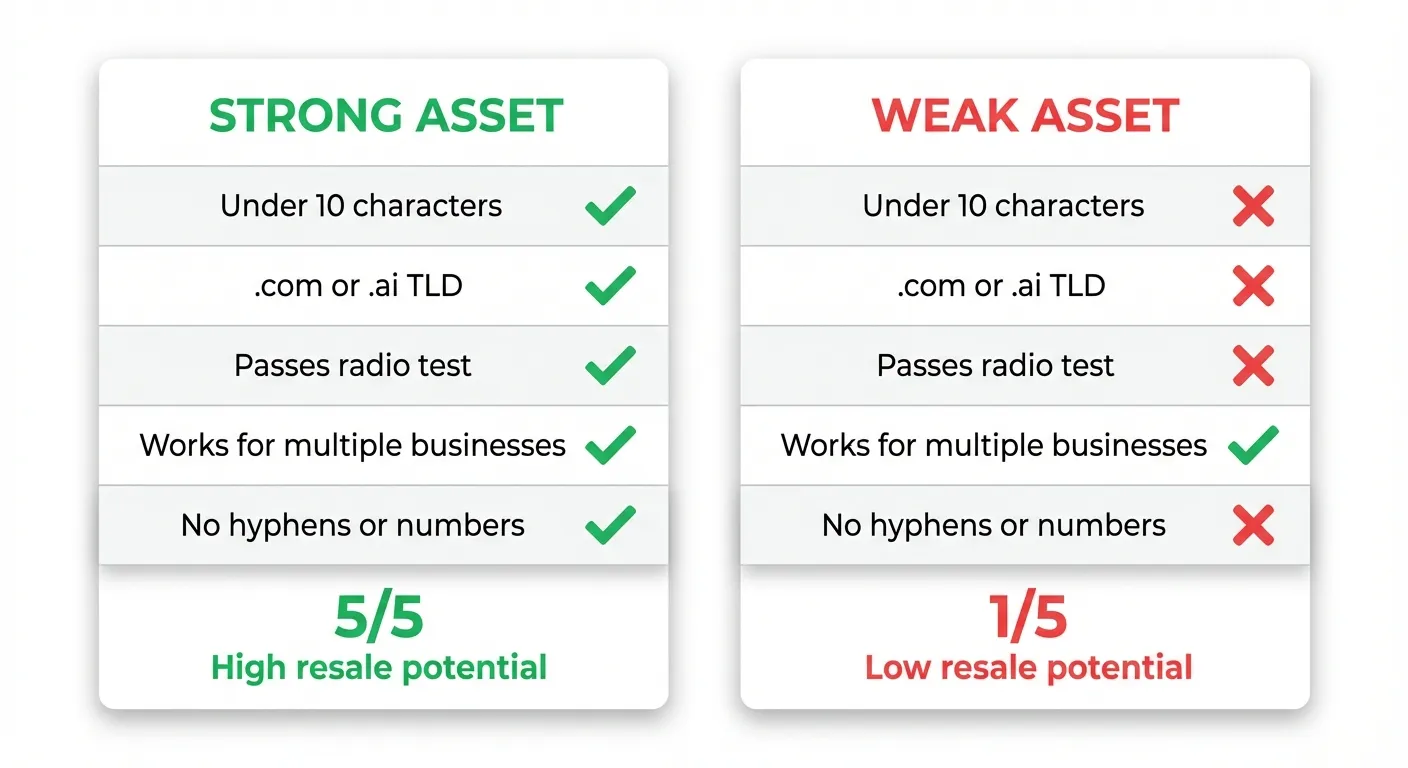
You don't need to be a professional domain investor to evaluate resale potential. Use this quick framework before registering any name.
Ask these five questions:
- Is it under 10 characters? Shorter names have larger buyer pools.
- Is it a .com, .ai, or .io? These TLDs have active resale markets.
- Can you say it once and have someone spell it correctly? The 5-minute brand audit covers this verbal clarity test in detail.
- Does it work for more than one business type? Category flexibility increases the number of potential buyers.
- Is it free from hyphens, numbers, and forced misspellings? Clean names hold value; gimmicky names don't.
Score each question yes or no. Four or five "yes" answers suggests strong resale potential. Two or fewer means you're likely picking a name that will depreciate.
The .ai Premium: A Case Study in TLD Value
The .ai extension deserves special attention. Originally the country code for Anguilla, it's become the de facto TLD for artificial intelligence companies - and the resale market reflects this.
In 2025, ai.com sold for $70 million, making it the most expensive domain sale of the year by a massive margin. But even mid-tier .ai domains are commanding strong prices. The Global Domain Report projected .ai registrations would hit 6 million, driven almost entirely by AI industry demand.
What makes this relevant for founders: if you're building an AI product, a .ai domain may actually appreciate faster than a comparable .com - at least in the current market. That said, .com still has the deepest resale market overall. The safest strategy is to secure your .com if available and consider .ai as a complement.
Resale Value vs. Brand Value
Here's where founders need to be honest with themselves. Resale value and brand value aren't always the same thing.
A quirky, creative name might be perfect for your brand but worthless on the aftermarket. A generic one-word .com might have high resale value but zero personality. The ideal is a name that scores well on both - but if you have to choose, brand fit should win.
Your domain's primary job is to support the business you're building right now. Resale value is a bonus, not the goal. Think of it like buying a house - you want a property that works for your life today, but you'd prefer one that also appreciates over time.
The practical approach: eliminate names that are actively bad investments (hyphens, obscure TLDs, excessive length) and then choose the best brand fit from what remains. You'll end up with a name that serves your business and retains financial value.
Building Long-Term Value
The domains that appreciate most share a pattern: they were good names that were held consistently. Here's how to protect and grow your domain's value over time.
- Renew early and auto-renew. Letting a domain lapse - even briefly - can destroy its value. Someone else may snap it up, or it may accumulate spam history.
- Build authority on it. A domain with real traffic, backlinks, and brand recognition is worth far more than an unused one. Every year you run a legitimate business on your domain, its value grows.
- Protect your brand. Register obvious misspellings and key TLD variants. This prevents competitors from squatting on adjacent names and protects your primary domain's value.
- Monitor the market. Tools like NameBio track comparable sales so you can benchmark your domain's value over time.
Making the Decision
Choosing a domain name is one of the few business decisions where you can simultaneously serve your brand and build a financial asset. The founders who get this right don't just find a name they like - they find a name that would hold value even if the business pivoted or sold.
Run your shortlisted names through the five-question framework above. Eliminate anything with obvious depreciation risks. Then pick the name with the strongest brand fit from what's left.
If you want to take the guesswork out of this entirely, URLGenie scores every domain candidate across multiple brand signals - including resale potential - so you can compare options with real data instead of gut feeling. It takes about five minutes to get ranked results with availability checks across multiple TLDs.
Your domain name is an asset. Treat the decision accordingly.