
A domain for $0.99. Another for $1.49. A .xyz for $0.88. Registrars plaster these offers everywhere, and for a founder watching every dollar, they look like no-brainers. Why spend more when a domain is a domain, right?
Not quite. That bargain-bin domain might come with invisible baggage - a spam history that tanks your email deliverability, a Google penalty that makes your site unfindable, or a renewal price that quietly triples next year. The problems don't show up at checkout. They show up months later, after you've built your brand on a foundation you didn't properly inspect.
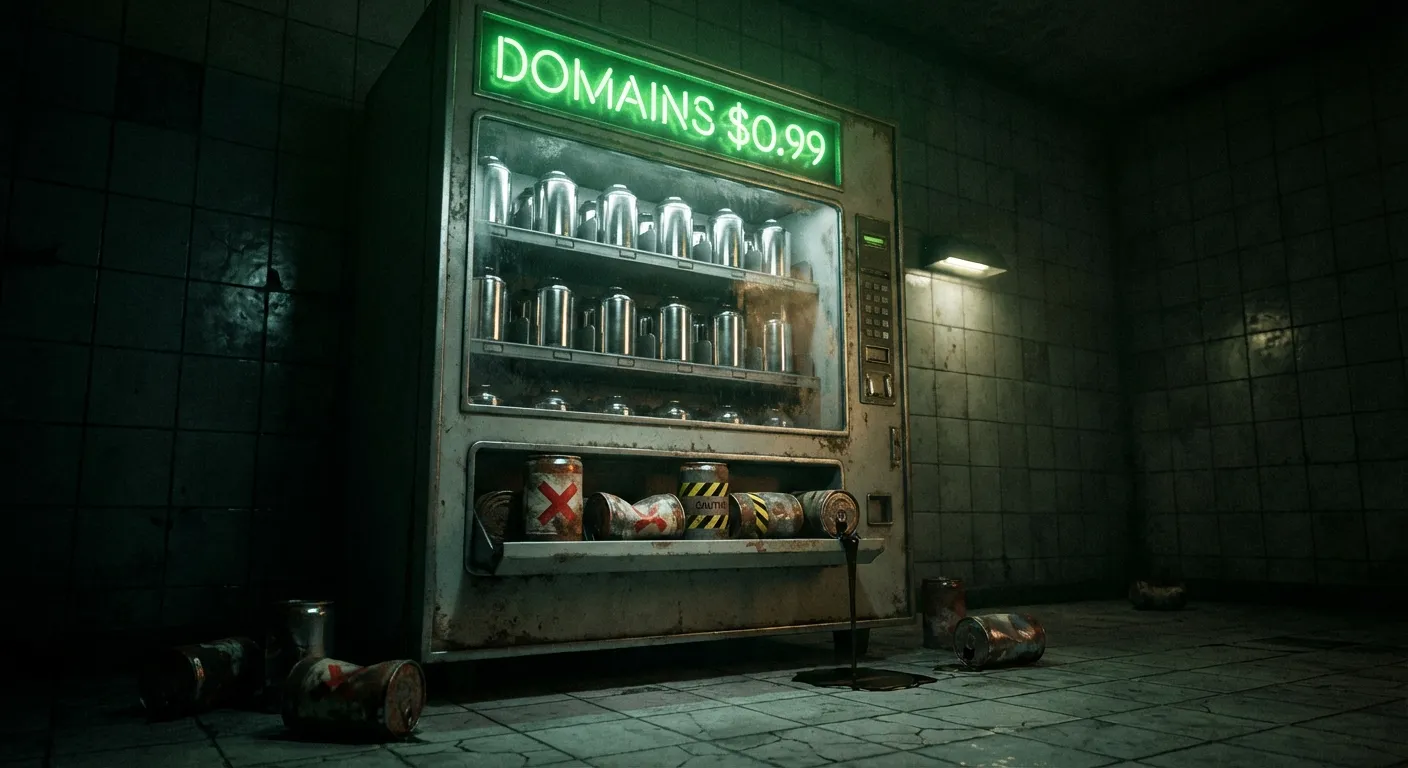
The Spam History You Can't See at Checkout
When you register a domain that was previously owned, you're inheriting its entire digital reputation. And many "cheap" domains are cheap precisely because they've been abandoned - often after being used for exactly the kind of activity that poisons a domain's standing.
Previous owners may have used the domain for:
- Spam email campaigns that got the domain listed on DNS blacklists
- Phishing pages that triggered browser and search engine warnings
- Malware distribution that landed the domain on security blocklists
- Black hat SEO with link farms and keyword stuffing that drew Google penalties
According to CircleID, Google-blacklisted sites can lose as much as 95% of their organic traffic. That's not a slow decline - it's near-total invisibility. If you unknowingly register a domain with this kind of history, you're starting your brand in a hole that can take months to climb out of.
The worst part? None of this shows up in the standard registration flow. You see a green checkmark and a low price. The blacklist entries, the toxic backlink profile, the cached search engine penalties - those are invisible until you start trying to use the domain for real business.
How to Check Before You Buy
Before committing to any domain - especially a suspiciously cheap one - run these checks:
- Google Transparency Report - Check if the domain has been flagged for unsafe content
- Wayback Machine - See what the domain previously hosted (spam, adult content, and phishing pages leave clear evidence)
- MXToolbox Blacklist Check - Scan across dozens of DNS blacklists simultaneously
- Backlink analysis tools - Services like Ahrefs or SEMrush reveal whether the domain has a toxic backlink profile from previous SEO manipulation
As we covered in our guide to verifying domain availability, a domain's technical status is only part of the picture. Reputation history matters just as much - and cheap domains are disproportionately likely to carry baggage.
The Renewal Price Trap
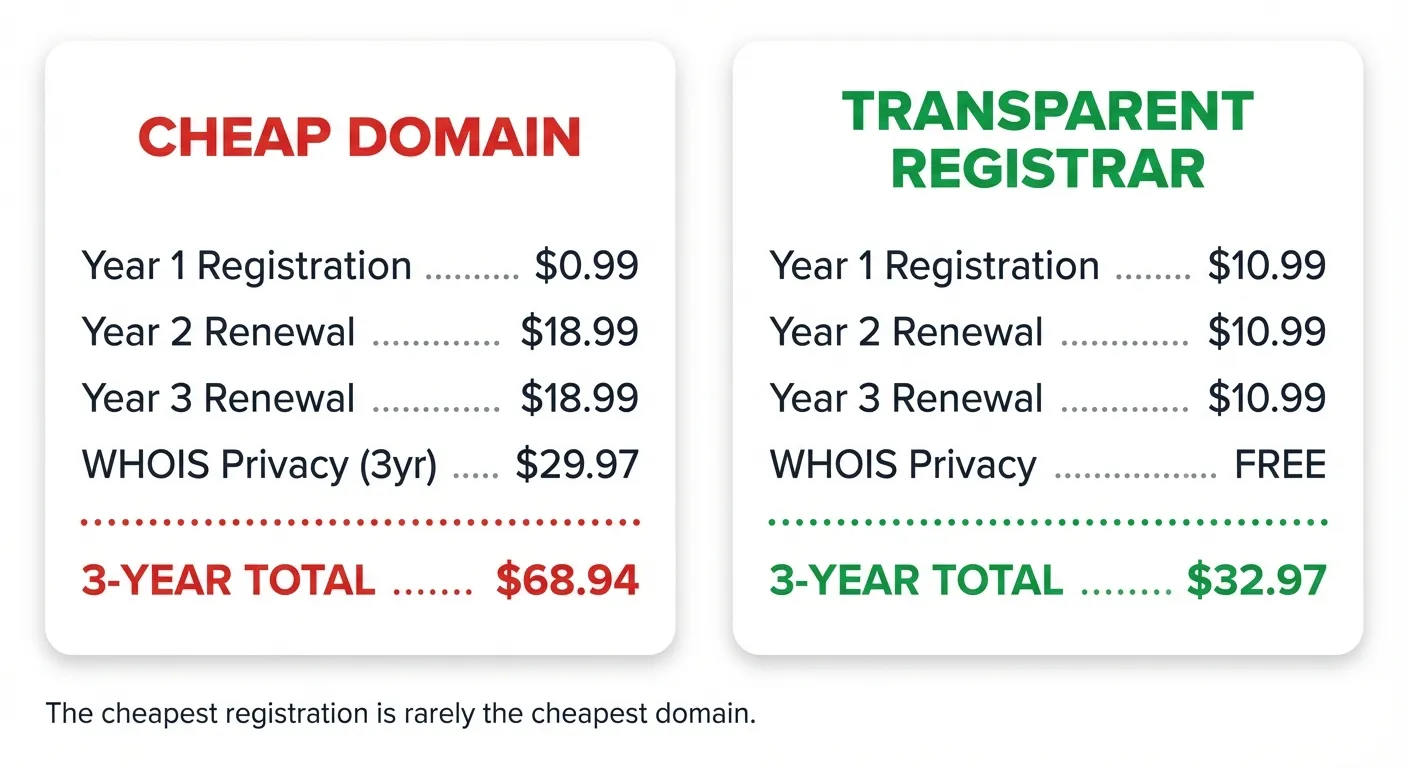
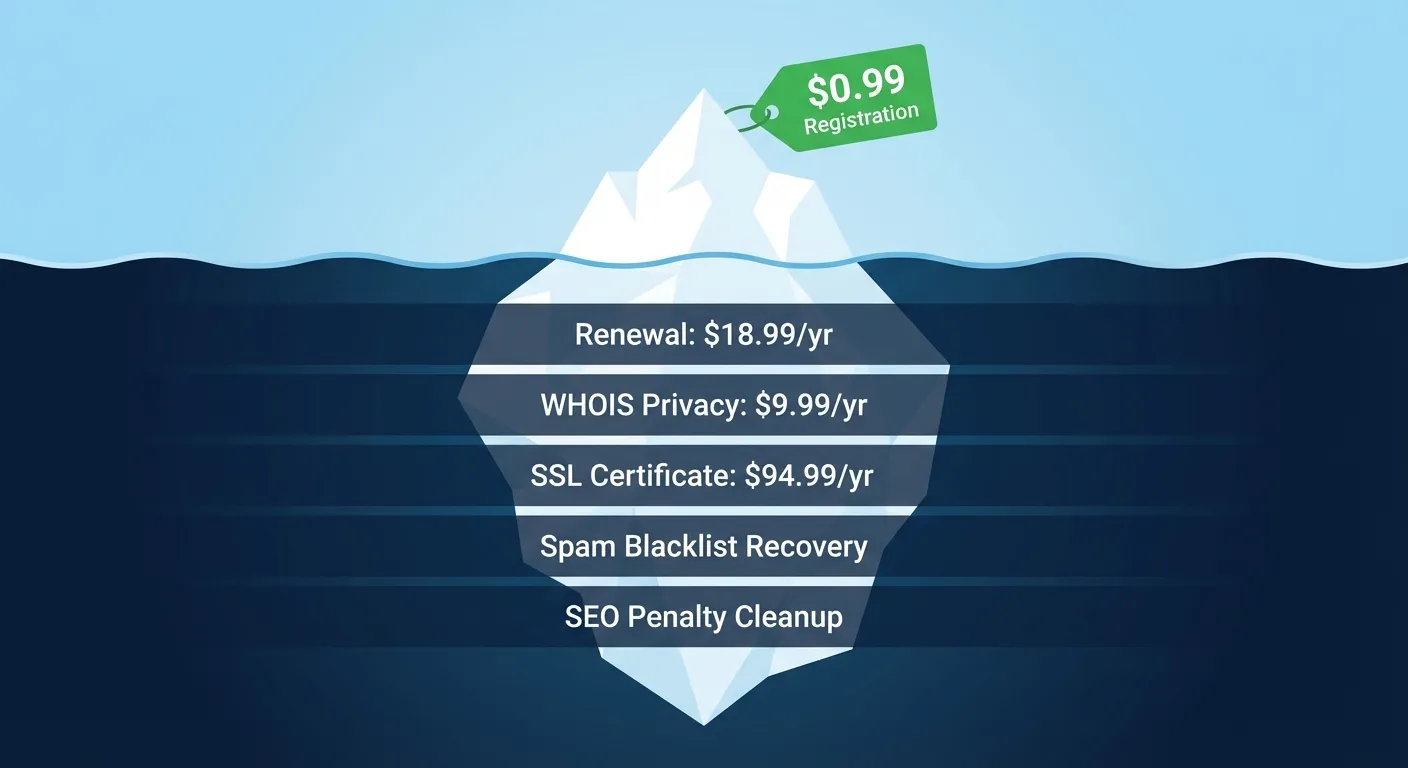
The $0.99 domain you registered today might cost $18.99 to renew next year. That's not a hypothetical - it's the standard pricing model for many major registrars.
Here's how the trap works:
- Year one: Registrar advertises an aggressively low promotional price
- You build your brand: Website goes live, business cards get printed, email gets configured
- Year two: Renewal notice arrives at 3x to 19x the original price
- You're locked in: Moving the domain means DNS changes, potential downtime, and email disruption
A UK industry analysis found renewal increases of up to 500% on some extensions - with one registrar jumping from roughly $2.50/year to over $60 for a two-year renewal. Across a portfolio of five domains, the annual cost difference between promotional and transparent pricing can exceed $90.
The real cost calculation isn't what you pay today. It's what you'll pay over three to five years. A domain at $12/year with consistent renewal pricing will cost less over five years than a $0.99 domain that renews at $18.99.
Cheap TLDs and the Spam Association Problem
Not all TLDs carry equal trust. Some newer, heavily discounted extensions have developed a reputation problem - not because of the TLD itself, but because their low prices attract bulk registrations from bad actors.
A 2025 ICANN-funded study analyzed 29,000 domains over two years and found that malicious domains cost an average of $4.71 to register, compared to $8.62 for legitimate ones. Registrars offering bulk discounts with automated registration APIs saw a 401% increase in abuse.
This creates a guilt-by-association problem. When a significant percentage of registrations on a particular TLD are spam or phishing, the entire extension develops a trust deficit:
- Email filters become more aggressive toward messages from those domains
- Browser security warnings trigger more frequently
- Users themselves develop skepticism when they see certain extensions in URLs
This doesn't mean every cheap TLD is toxic. But if you're choosing a domain purely because the extension is the cheapest option, you should understand that your emails might face higher scrutiny and your visitors might trust you less - before they even see your content.
Email Deliverability: The Invisible Killer
For many startups, email is the primary revenue channel - cold outreach, transactional messages, newsletters, support replies. A domain with compromised email reputation can quietly destroy this channel before you even realise something is wrong.
Here's what happens when you register a domain with spam history:
- Gmail, Outlook, and Yahoo check domain reputation before deciding where to place your emails
- A domain previously used for bulk spam may already be on Spamhaus or other major blocklists
- Even if you've removed the old content, the domain's reputation persists in these databases
- Your legitimate business emails land in spam folders - or get rejected entirely
A Spamhaus listing alone can reduce email deliverability by over 60%, according to Prospeo's diagnostic guide. For a startup relying on cold email, that's the difference between a growing pipeline and silence.
The fix isn't quick either. Cleaning up a domain's email reputation requires:
- Identifying and requesting removal from every blacklist
- Configuring SPF, DKIM, and DMARC authentication records
- Gradually "warming up" the domain's sending reputation over weeks
- Maintaining complaint rates below 0.3% throughout the process
Some founders spend months rehabilitating a domain they could have avoided in the first place.
The Hidden Cost of "Free" Extras
Cheap domain deals often come bundled with add-ons that aren't as free as they appear:
- "Free" SSL certificates that auto-renew at $50 to $95/year
- WHOIS privacy charged at $5 to $12/year per domain (when many registrars include it free)
- Email forwarding that requires paid upgrades for basic functionality
- DNS management fees for features that should be standard
These extras can double or triple your actual annual domain cost. When comparing domain prices, always calculate the total cost of ownership including privacy protection, SSL, and DNS management - not just the headline registration fee.
When a Cheap Domain Actually Makes Sense
To be fair, not every cheap domain is a trap. There are legitimate scenarios where a low-cost domain works fine:
- Short-term campaign or landing pages - If you only need the domain for months, not years, renewal pricing matters less
- Testing and prototyping - Validating an idea before committing to a premium domain
- Redirects - Buying common misspellings of your primary domain to catch stray traffic
- Brand-new TLDs with genuine introductory pricing - Some extensions launch with promotional pricing that reflects their newness, not a bait-and-switch strategy
The key question is: are you building a long-term brand on this domain? If yes, the $5 you save today isn't worth the risk. If you're running a two-week experiment, the calculus changes.
A Smarter Approach to Domain Investment
Your domain isn't a commodity purchase like a pack of printer paper. It's a foundational brand asset that affects your SEO, your email deliverability, your customer trust, and your professional credibility. As we covered in our domain scoring guide, a domain's value goes far beyond its registration price. Treating it as the line item to minimise is a false economy.
Here's what to prioritise instead:
- Transparent renewal pricing - Choose registrars where year-one and renewal prices are the same or clearly stated upfront
- Reputation verification - Check blacklists, backlink profiles, and content history before registering any previously owned domain
- TLD credibility - Select an extension that carries trust in your industry, even if it costs a few dollars more. A brandable domain on a reputable TLD will outperform a generic keyword domain on a cheap one
- Total cost of ownership - Include privacy, SSL, and DNS in your comparison, not just the headline price
URLGenie helps with the strategic side of this equation. When we score domains, we're evaluating long-term brand value - not just whether a name is available at the lowest possible price. The scoring factors in authority, SEO potential, and resale value specifically because a domain's worth compounds over years, not days.
The Bottom Line
The cheapest domain on the page is almost never the best value. Between spam blacklists that kill your email, SEO penalties that bury your site, renewal prices that silently multiply, and TLD associations that erode trust - the hidden costs of a "cheap" domain can dwarf whatever you saved at registration.
Spend the extra $10. Check the history. Verify the renewal price. Choose a TLD that carries weight in your market. Your future self - the one trying to build a brand, not debug a blacklist entry - will thank you.
If you want to evaluate domains on more than just price, try URLGenie - it scores names across brand fit, verbal clarity, authority, SEO potential, and resale value, so you can make a decision you won't need to undo later.