
You remember "Google" but not the search engine you tried before it. You remember "Stripe" but not that other payment tool your co-founder suggested. Some names lodge in your brain after a single exposure. Others evaporate before you finish closing the tab.
This isn't random. Decades of cognitive science research explain exactly why certain names stick and others don't - and the principles apply directly to choosing a domain name. Understanding them won't just help you pick a better name. It will help you understand why certain names feel right, so you can stop second-guessing and start deciding with confidence.
Your Brain Has a Bottleneck (And Your Domain Must Fit Through It)
In 1956, psychologist George Miller published one of the most cited papers in cognitive science. His finding: human working memory can hold roughly seven items (plus or minus two) at any given moment. Everything you encounter competes for those limited slots.
This has direct consequences for domain names. As research on memorable domains demonstrates, names under 10 characters with simple consonant-vowel patterns are significantly easier to encode into working memory. Longer names, or names with consonant clusters that are hard to chunk, burn through working memory capacity before the brain can store them.
Think about the names that dominate their categories:
- Zoom - 4 characters
- Uber - 4 characters
- Slack - 5 characters
- Stripe - 6 characters
- Notion - 6 characters
None of them tax working memory. They slip through the bottleneck effortlessly. Compare that with "CollaborativeDesignPlatform.com" - by the time you've processed the third word, the first is already fading.
The practical rule: If your domain name uses more than two or three syllables, it needs to compensate with strong phonetic patterns, emotional resonance, or associative meaning. Otherwise, working memory will discard it.
The Distinctiveness Effect: Why Invented Names Win
In 1933, psychiatrist Hedwig von Restorff discovered something that brand namers still rely on today. When people see a list of similar items with one distinctive item mixed in, they remember the distinctive one far better. This became known as the Von Restorff effect, or the isolation effect.
Domain names operate in exactly this environment. Your name appears alongside competitors in search results, social feeds, and conversations. If it looks and sounds like everything else in the category, the brain files it under "generic" and moves on. If it's distinctive, the brain flags it for deeper encoding.
This is why invented names outperform descriptive alternatives. "Zillow" occupies a unique memory position that "CheapHousesOnline" never could. "Spotify" is distinctive in a way that "MusicStreamingService" isn't. The invented name triggers what psychologists call an isolation effect - it stands out from the pattern, so the brain encodes it more deeply.
The lesson isn't that every domain needs to be a made-up word. It's that distinctiveness drives recall. Whether you achieve it through an unexpected real word (Apple), an invented word (Spotify), or an unusual metaphor (Amazon), the goal is the same: create enough contrast with the surrounding landscape that the brain treats your name as noteworthy. For practical techniques on creating these kinds of names, our guide on choosing a brandable domain name covers five proven approaches.
Sound Symbolism: Your Brain Judges Sounds Before Meaning
Perhaps the most fascinating area of naming psychology is sound symbolism - the phenomenon where individual sounds carry inherent meaning, independent of the words they form.
The classic demonstration is the bouba/kiki effect. Show people two shapes - one round, one jagged - and ask which is "bouba" and which is "kiki." Across languages and cultures, roughly 95% of people assign "bouba" to the round shape and "kiki" to the jagged one. The brain maps sounds to physical properties before conscious processing even begins.
This isn't a curiosity. It has measurable effects on how consumers perceive brands. Research published in the Journal of Consumer Research found that phonetic structure directly influences product evaluation - consumers infer product attributes from the sounds in a brand name, and this process is automatic, outside awareness, and effortless.
Here's what the research tells us about specific sound types:
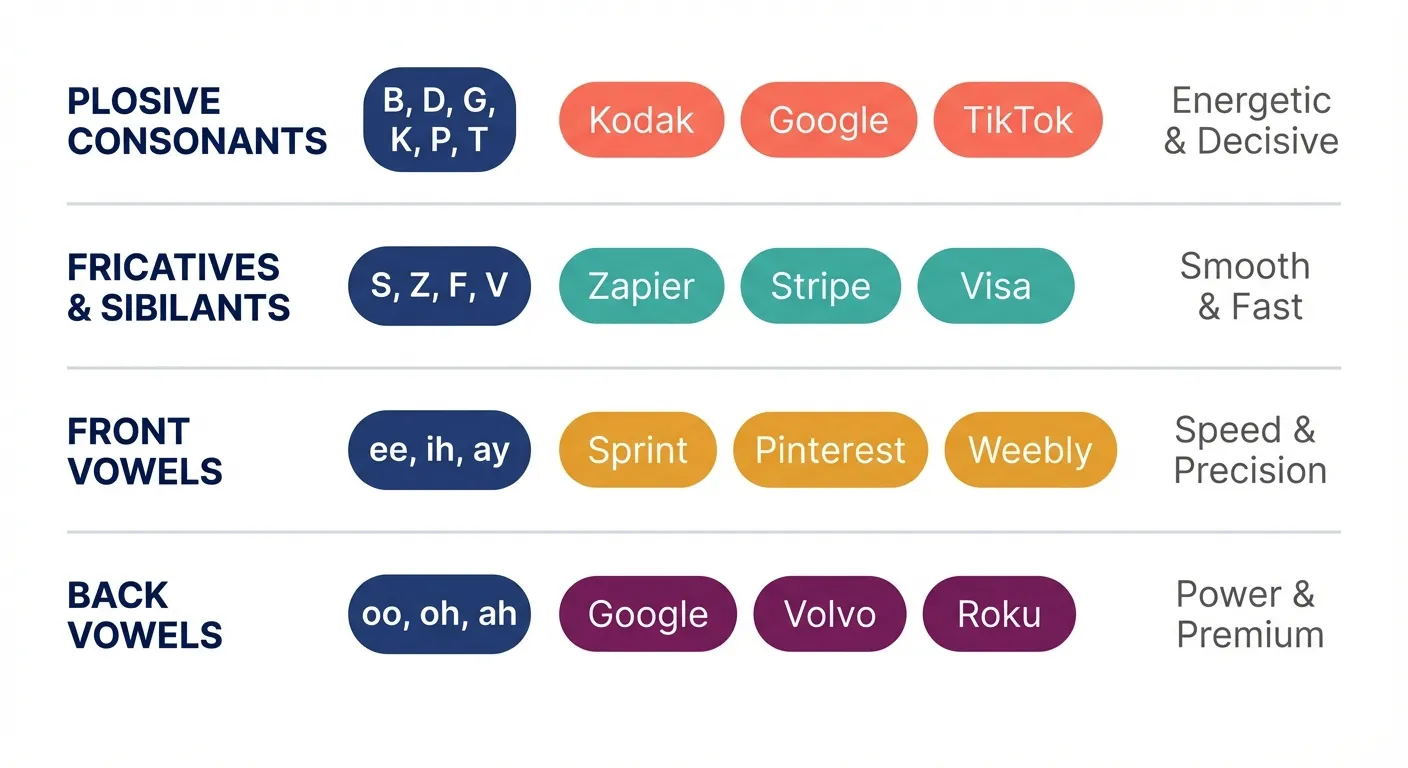
- Plosive consonants (B, D, G, K, P, T) are processed faster by the auditory cortex. They feel energetic and decisive. Think: Kodak, Google, TikTok.
- Fricative and sibilant sounds (S, Z, F, V) feel smooth, sophisticated, or fast. Think: Zapier, Stripe, Visa.
- Front vowels (ee, ih, ay) suggest smallness, speed, or precision. Think: Sprint, Pinterest, Weebly.
- Back vowels (oo, oh, ah) suggest largeness, power, or premium quality. Think: Google, Volvo, Roku.
Matching Sound to Brand Personality
The key insight from sound symbolism research is congruency. When a name's sounds match the product's attributes, consumers rate the product more favourably - even when they can't explain why.
A fintech product benefits from sharp plosives and front vowels that suggest precision and speed. A wellness brand benefits from soft consonants and back vowels that suggest calm and depth. The sounds should reinforce the brand personality, not fight against it.
This doesn't mean you need a linguistics degree to name your business. But it does mean you should say your shortlisted names out loud and notice the feeling they create. If you're building something that should feel powerful and authoritative, a name full of soft, whispery sounds will create a subtle mismatch that customers sense without being able to articulate.
Processing Fluency: Easy Names Feel More Trustworthy
The single most robust finding in naming psychology is processing fluency - the easier something is to mentally process, the more positively we evaluate it. Easy-to-read, easy-to-say names feel more trustworthy, more familiar, and more likeable, even on first exposure.
This isn't opinion. It's been demonstrated across dozens of studies: people subconsciously associate "easy to process" with "trustworthy" and "safe." A domain name that flows naturally triggers a positive gut response. One that requires decoding - unusual spellings, unexpected letter combinations, ambiguous pronunciation - creates cognitive friction that registers as mild discomfort.
Processing fluency explains several naming patterns:
- Why common letter patterns beat creative spellings. "Flickr" works despite the missing vowel because Flickr spent millions on advertising. Most startups can't afford to override the fluency penalty.
- Why alternating consonant-vowel patterns are easier to recall. Names like "Roku" (consonant-vowel-consonant-vowel) align with how the brain naturally segments speech sounds.
- Why domain names with numbers and hyphens underperform. "Best4U-Deals.com" requires the brain to switch between processing modes (letters, numbers, symbols), creating friction at each transition.
The practical implication is clear: when you're torn between a clever-but-complex name and a simple-but-clean one, the research consistently favours simplicity. For a framework on evaluating this and other factors systematically, our 5-minute brand audit walks through the key signals.
Trust Heuristics: The Snap Judgments You Can't Override
When someone encounters your domain name for the first time - in a search result, a social post, or a friend's recommendation - they don't carefully evaluate your credibility. They use cognitive heuristics: mental shortcuts that produce fast judgments with minimal effort.
Research on trust in domain names identifies several heuristics that fire within milliseconds:
The Familiarity Heuristic
The mere exposure effect, first documented by psychologist Robert Zajonc in 1968, shows that familiarity breeds preference. We instinctively prefer what we recognise over what we don't. This is why .com still carries a trust premium - it's the domain extension people have seen most often throughout their lives.
But the familiarity heuristic goes deeper than TLDs. Names built from recognisable word roots feel more trustworthy than completely opaque invented words. "MailChimp" combines two familiar words into something new. "Xylqr" is shorter and more distinctive, but it triggers zero familiarity signals.
The Authority Heuristic
Certain naming patterns signal authority: brevity, dictionary words, premium TLDs. Research shows that credibility judgments occur within 50 milliseconds - faster than conscious thought. Your domain needs to pass this snap test before anything else matters.
Short, clean domain names signal resources and permanence. They imply that the company is established enough to have secured a prime piece of digital real estate. This is why a one-word .com carries more perceived authority than a three-word .xyz, regardless of the actual business behind it.
The Simplicity Heuristic
When information is hard to process, the brain defaults to scepticism. Dashes, numbers, unusual TLDs, and misspellings all increase cognitive load. Each point of friction is a micro-signal that something might be off. It's not rational - "best-deals-4u.biz" might be a perfectly legitimate business - but heuristic processing doesn't wait for rational evaluation.
Emotional Encoding: The Memory Multiplier
Neuroscience research confirms what marketers have long intuited: emotions strengthen memory encoding. The amygdala tags emotionally significant experiences for priority storage, which is why you remember where you were during a major event but not what you had for lunch three Tuesdays ago.
Domain names can leverage this through emotional resonance. Names that evoke curiosity, excitement, or warmth create stronger memory imprints than emotionally neutral ones.
Consider the difference:
- Kickstarter evokes the excitement of launching something new
- FreshBooks triggers associations with cleanliness and organisation
- Headspace immediately conjures a feeling of calm clarity
Compare those with functionally descriptive alternatives like "CrowdfundingPlatform," "AccountingSoftware," or "MeditationApp." The descriptive names are easier to understand but harder to remember, because they don't trigger any emotional tagging.
The naming sweet spot is a name that's emotionally evocative and cognitively fluent. "Calm" achieves both - it's one syllable, universally understood, and emotionally resonant. That combination is why certain names feel effortless to remember. Our complete business naming guide covers how to balance these factors across different industries.

Putting the Psychology to Work
Understanding these principles is useful. Applying them is what actually changes outcomes. Here's how to use cognitive science when evaluating domain name candidates:
Test for Working Memory Fit
Count syllables, not just characters. A 12-character name with three syllables ("Instagram") is easier to encode than an 8-character name with four syllables ("Elevatory"). Aim for one to three syllables whenever possible.
Check for Distinctiveness
Search your name alongside competitors. Does it blend in or stand out? If you lined up ten names in your category, would yours be the one people remember five minutes later? If not, it lacks the Von Restorff isolation effect you need.
Listen for Sound-Meaning Congruency
Say the name out loud. Does it sound like what your brand should feel like? A cybersecurity company named "Lullaby" creates a sound-meaning mismatch. A children's app named "Krypt" does the same. Trust the instinct - it's sound symbolism doing its job.
Measure Processing Fluency
The simplest test: say your domain name to five people and ask them to spell it back. If more than one person gets it wrong, your name has a fluency problem. This is the classic "radio test" - and processing fluency research explains exactly why it works.
Assess Emotional Resonance
Ask yourself: does this name make me feel something? Even a subtle emotional response - curiosity, energy, warmth - means the amygdala is engaged, and that means stronger encoding. If the name feels flat or purely functional, it will be harder for customers to remember.
The Cognitive Science Bottom Line
The psychology of domain names isn't abstract theory. It's a practical lens for making one of your most important brand decisions. The principles are clear:
- Respect working memory limits - keep names short and phonetically simple
- Be distinctive - generic names get filed under "forgettable"
- Match sounds to meaning - your name's phonetics should reinforce your brand personality
- Prioritise fluency - easy to process means easy to trust
- Create emotional resonance - feelings strengthen memory
Every successful brand name you can think of leverages at least two or three of these principles. Most leverage all of them. That's not coincidence - it's cognitive science at work.
If you want to evaluate names against these principles systematically, URLGenie scores domain candidates across brand fit, verbal clarity, authority, SEO potential, and resale value - turning subjective "does this feel right?" into data you can compare. But whether you use a tool or apply these principles manually, the science is the same: names that work with the brain's architecture get remembered. Names that fight against it get forgotten.