
Someone told you that putting keywords in your domain name would boost your rankings. Maybe they told you in 2015. Maybe last week. Either way, the advice is outdated - and following it in 2026 could actively hurt your search visibility.
The relationship between domain names and SEO has fundamentally shifted. Your domain still matters for search performance, but the reasons why have almost nothing to do with keywords and almost everything to do with brand signals.

The Myth That Won't Die: Keywords in Your Domain
For years, exact match domains (EMDs) - domains like "best-organic-dog-treats-online.com" - gave sites a measurable ranking boost simply because the domain matched search queries. Google's 2012 EMD update was supposed to end this, but the myth persists.
Here's what the data actually shows in 2026:
- Keywords in your URL have been relegated to near-irrelevance. First Page Sage's 2025 algorithm study found that "Keyword in URL" now sits among 23+ minor factors sharing just 1% of total algorithm weight - down from being a standalone signal in previous years.
- Google's John Mueller has explicitly cautioned businesses against generic keyword domains, noting they make it harder to stand out. His exact words: "I see a lot of small businesses make the mistake of taking a generic term and calling it their brand."
- EMDs create a competition trap. When your domain is a generic phrase, you compete against every directory, aggregator, and established player targeting those same terms. As Search Engine Land's analysis puts it: "Search engines favor authority and branding over keywords alone."
The bottom line: a keyword in your domain provides almost zero direct ranking benefit. If you chose your domain primarily for SEO keyword value, you built on a foundation that no longer exists.
What Your Domain Actually Signals to Google
If keywords don't matter, what does? Your domain name influences SEO through indirect signals that compound over time. These are harder to game - which is exactly why Google weights them.
Branded Search Volume
This is the big one. When people search for your brand name specifically, Google treats it as a powerful trust signal.
The May 2024 Google API leak revealed that Google's systems contain a function that tracks brand-specific search volume and factors it into rankings - "essentially working as a trust factor similar to links." A Moz study following the leak found that sites with strong backlink profiles but low branded search volume were disproportionately hit by Google's Helpful Content Updates.
What this means for your domain: A distinctive, memorable name generates branded searches. A generic keyword domain doesn't. Nobody searches for "BestCloudSolutions.io" by name - they search for the generic term, where you're one result among thousands.
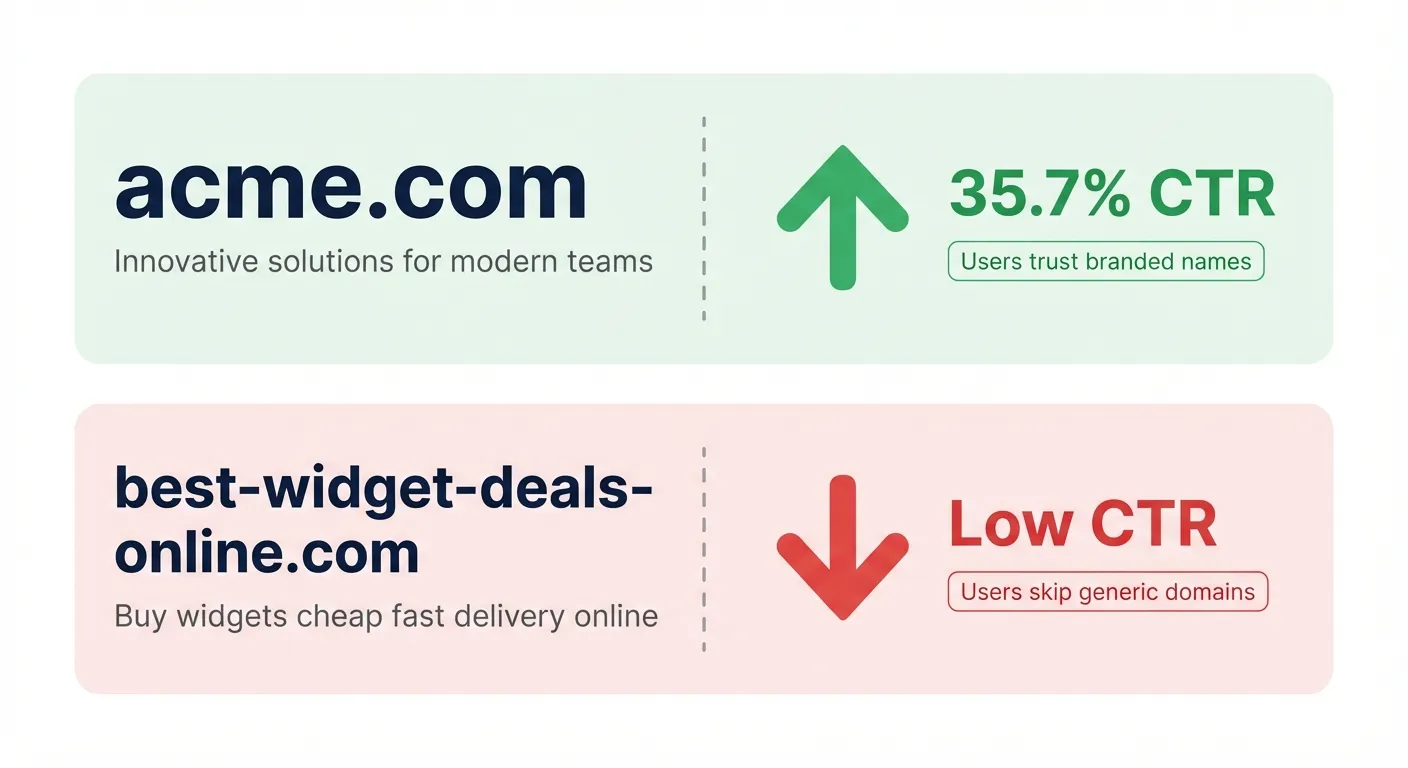
According to Sitebulb's 2025 research, branded queries capture 35.68% CTR at position one versus 28.16% for non-branded queries. That click-through advantage feeds directly into engagement metrics that Google rewards.
Click-Through Rate and User Trust
Your domain name appears in every search result snippet. Users make split-second judgments about whether to click based partly on the URL they see.
A brandable domain like "Stripe" or "Notion" signals legitimacy. A keyword-stuffed domain like "FastPaymentProcessorOnline.com" signals the opposite - it looks like spam, a directory, or an affiliate site. Lower click-through rates mean fewer engagement signals, which means lower rankings over time.
Entity Recognition in AI Search
The rise of AI-powered search (Google's AI Overviews, ChatGPT search, Perplexity) has introduced a new dimension. These systems need to identify your brand as a distinct entity to cite you in responses.
Ahrefs research found that "Branded Web Mentions" correlated most strongly with being cited in AI Overviews - outperforming traditional metrics like backlink counts. If your domain is a generic phrase, AI systems struggle to distinguish your site from the concept itself.
A domain like "CloudStorageHub.com" is nearly invisible to AI search because it blends with generic mentions of cloud storage. A distinctive name becomes a citable entity.
The Five Domain Factors That Actually Impact SEO
Not all domain choices are created equal for search performance. Here's what genuinely moves the needle.
1. Memorability Drives Return Visits
Searcher engagement accounts for roughly 12% of Google's algorithm according to First Page Sage. Return visits, time on site, and pages per session all contribute. A domain people can remember and type directly brings them back - feeding those engagement signals.
This is why the "radio test" matters for SEO, not just branding. If someone hears your name on a podcast and can spell it correctly in a browser, you've just earned a direct visit that strengthens every ranking signal on your site.
2. Domain History and Spam Footprint
Buying a previously registered domain can be a shortcut or a trap. DomainRaider's research found that "past involvement in spam, manipulative link schemes, doorway pages, or malicious activity can leave behind manual actions or lingering algorithmic filters" - even after ownership changes.
Before registering any domain, check:
- Wayback Machine for previous content (was it a gambling site? A link farm?)
- Backlink profile for toxic or spammy inbound links
- Blacklist status for email spam or malware flags
A clean domain with no history is almost always safer than a "premium" expired domain with unknown baggage.
3. TLD Choice Affects Trust, Not Rankings
Google has confirmed that generic TLDs (.com, .ai, .io, .app) are treated equally for ranking purposes. But user trust varies significantly, and trust affects click-through rates, which affect rankings.
As we covered in our complete domain guide, .com still commands the highest default trust. Specialty TLDs like .ai can signal industry relevance for AI companies, but obscure TLDs can raise user suspicion and reduce clicks.
4. Domain Length and Typability
Shorter, cleaner domains earn more direct type-in traffic and are easier to share. Every character you add is another opportunity for a typo that sends potential visitors elsewhere. This matters for SEO because direct traffic is a trust signal - sites that people navigate to directly are sites Google considers authoritative.
5. Brandability Creates a Compounding SEO Advantage
This is where everything connects. A brandable domain name:
- Generates branded searches (the strongest trust signal)
- Earns higher CTR in search results (engagement signal)
- Gets cited by AI search (entity recognition)
- Drives word-of-mouth traffic (direct visits)
- Attracts natural backlinks (people link to brands, not generic sites)
Each of these feeds the others. A keyword domain does none of them. Over months and years, the gap compounds dramatically - and as we explored in our piece on why keyword mashing kills brands, the damage extends well beyond search rankings into credibility and customer trust. If you're wondering how to build a brandable name instead of defaulting to keywords, our guide to brandable domains walks through the process.
Warning Signs Your Domain Is Hurting Your SEO
How do you know if your current domain is dragging down your search performance? Watch for these red flags.
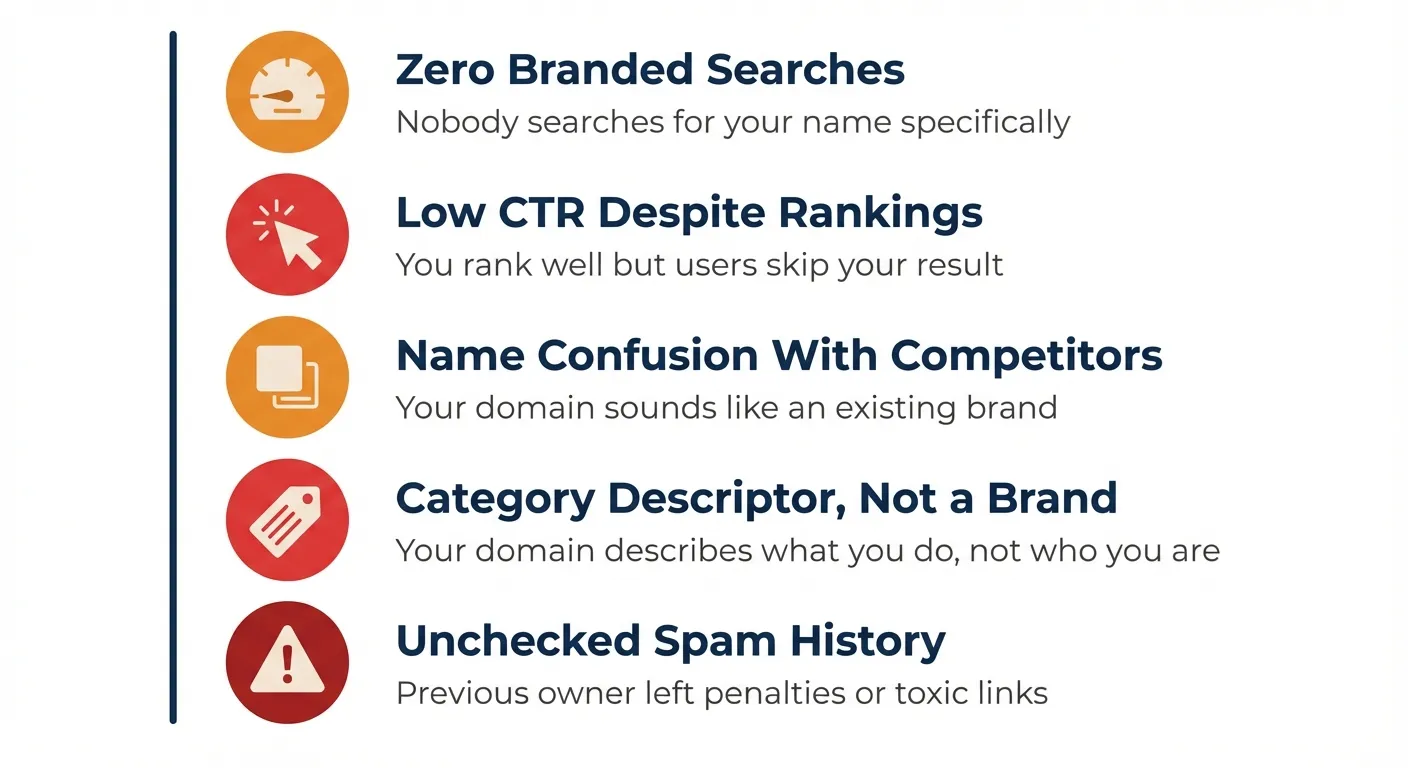
- Zero branded search volume. Check Google Search Console for queries containing your brand name. If nobody searches for you by name, Google has no brand signal to work with.
- Low CTR despite good rankings. If you rank on page one but get fewer clicks than expected, your domain might be signalling "spam" or "generic" to users scanning results.
- Confusion with competitors. If your domain is similar to established players, you're splitting brand signals and potentially triggering Google's entity disambiguation - which rarely works in the smaller brand's favour.
- Your domain describes your category, not your brand. "OnlineAccountingSoftware.com" competes with the concept of online accounting software. You can't own that term, and Google knows it.
- Previous spam history you didn't check. Inherited penalties and toxic backlinks can suppress rankings for months or years after a domain changes hands.
What to Do If You're Starting Fresh
If you haven't picked a domain yet, you're in the best position. Optimise for the signals that actually matter:
- Choose a distinctive, memorable name that passes the radio test
- Prioritise brandability over keyword inclusion
- Check domain history before registering anything previously owned
- Pick a TLD your audience trusts (.com when possible, industry-relevant alternatives when not)
- Keep it short and typable - every character counts
The irony of domain names and SEO in 2026 is that the best SEO domain is one you didn't choose for SEO reasons. It's the name that people remember, search for, click on, and talk about. Those human behaviours are what Google actually measures - and they all start with a name worth remembering.
URLGenie helps you find exactly that kind of name - distinctive, brandable domains scored across multiple metrics including SEO potential, so you can make a data-driven choice instead of guessing.