
A pre-seed founder naming their startup at 2am on their laptop has a fundamentally different set of constraints than a Series A company with $10M in the bank and enterprise clients in the pipeline. Yet most naming advice treats them identically: "get the .com," "hire a branding agency," "make it memorable."
The right naming strategy depends on where you are. What matters at pre-seed will be irrelevant at Series A, and what Series A companies can afford would bankrupt a bootstrapped founder.
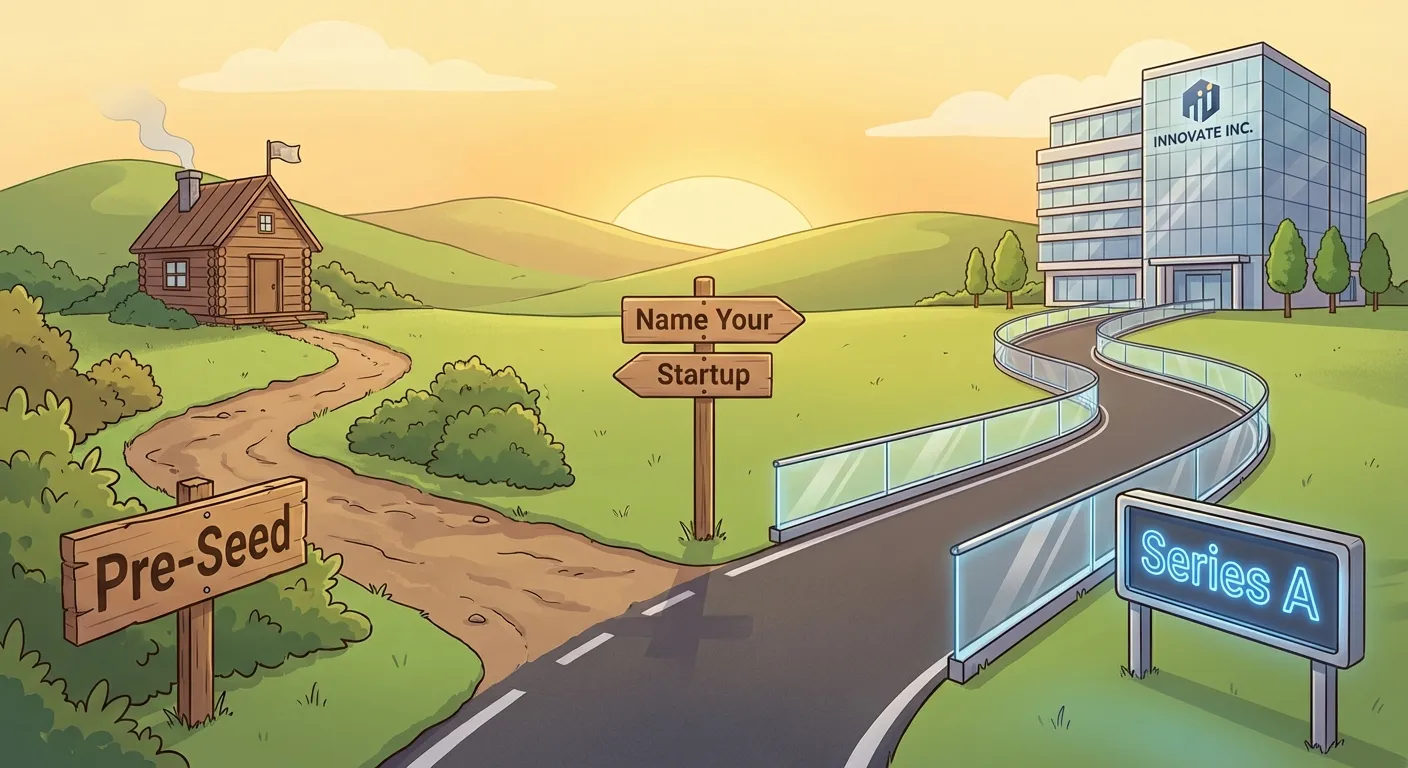
Pre-Seed: Speed and Survival
At pre-seed, your product might pivot three times before finding market fit. Data suggests that 1 in 3 early-stage ventures revisit their name within the first 36 months. Spending weeks perfecting a name for a product that might not exist in six months is a misallocation of your scarcest resource: time.
What pre-seed founders should optimise for:
- Speed over perfection. A good-enough name that lets you launch this week beats a perfect name that delays you by a month. As we covered in our startup domain guide, speed to market has compounding effects.
- Low cost. Your naming budget is effectively zero. .io ($25-60/year), .app ($14-20/year), and .ai ($60-100/year) are all legitimate options. Don't spend $5,000 on an aftermarket .com when you don't know if the business will exist in a year.
- Flexibility. Choose a name that can survive a pivot. A brandable, abstract name is safer than a descriptive one at this stage - you don't know what you're building yet.
- Verbal clarity. Even on a tight budget, don't compromise on pronounceability. The "radio test" matters from day one because word-of-mouth is your primary growth channel pre-funding.
What pre-seed founders should NOT worry about:
- Having the .com (alternative TLDs are fine and expected)
- Trademark registration (do a basic search, but formal filing can wait)
- Brand agency input ($5,000-$50,000 is an absurd spend at this stage)
- Perfect SEO alignment (your name won't make or break search rankings early on)
The pre-seed naming process:
- Generate 50+ candidates using AI tools or structured brainstorming
- Filter for verbal clarity and availability
- Do a basic Google and trademark search
- Register the domain on whatever TLD is available and affordable
- Move on and build the product
Total time budget: one afternoon. Total cost: under $100.
Series A: Credibility and Scale
By Series A, the game has changed. You have customers, revenue, and investors who expect a certain level of professionalism. Your name now appears in press coverage, sales decks, enterprise procurement processes, and conference programmes.
What Series A companies should optimise for:
- Credibility signals. Enterprise buyers care about domain authority. A .com carries more weight in a procurement evaluation than a .io, and a clean brand domain signals stability. This is the stage where the agency-vs-AI question becomes worth asking seriously.
- Legal protection. File trademark applications. Register defensive domains (common misspellings, key TLD variations). You now have something worth protecting.
- Brand consistency. Ensure your name, domain, email, social handles, and legal entity all align. Mismatches that were tolerable at pre-seed become friction points at scale.
- Domain upgrade potential. If you're on a .io or .ai and planning enterprise sales, start looking at acquiring the .com. Companies like Baseten upgraded from .co to .com around their Series C. Lingopal secured the .com alongside their Series A while keeping .ai as the primary.
The domain upgrade budget at Series A:
| Domain Type | Typical Cost | When It's Worth It |
|---|---|---|
| Clean .com (aftermarket) | $5,000-$30,000 | Enterprise sales, consumer brand |
| Premium .com (broker) | $30,000-$250,000+ | Category-defining brand |
| Defensive registrations | $100-$500/year | Any company with customers |
| Trademark filing | $250-$2,000 | Always at this stage |
When to Rebrand (and When Not To)
The biggest naming mistake isn't choosing the wrong name initially - it's either rebranding too early (wasting pre-seed resources) or too late (letting a bad name accumulate years of friction).
Rebrand signals at Series A:
- Your name describes your original product but you've expanded beyond it
- Enterprise clients consistently misspell or mispronounce your name
- There's a trademark conflict you've been ignoring
- Your domain creates confusion with a competitor
- Your name has become an inside joke rather than a brand asset
Do NOT rebrand if:
- The name is "fine but not amazing" - brand equity compounds, and switching costs are real
- You're rebranding for aesthetic reasons rather than strategic ones
- You don't have budget to execute the rebrand properly (half-done rebrands are worse than no rebrand)
Real examples show rebranding at funding milestones is increasingly common and well-received. CodiumAI rebranded to Qodo alongside their $40M Series A. Nymble became Posha before their $8M raise. In each case, the rebrand signalled strategic maturity, not failure.
The Stage-Appropriate Naming Stack
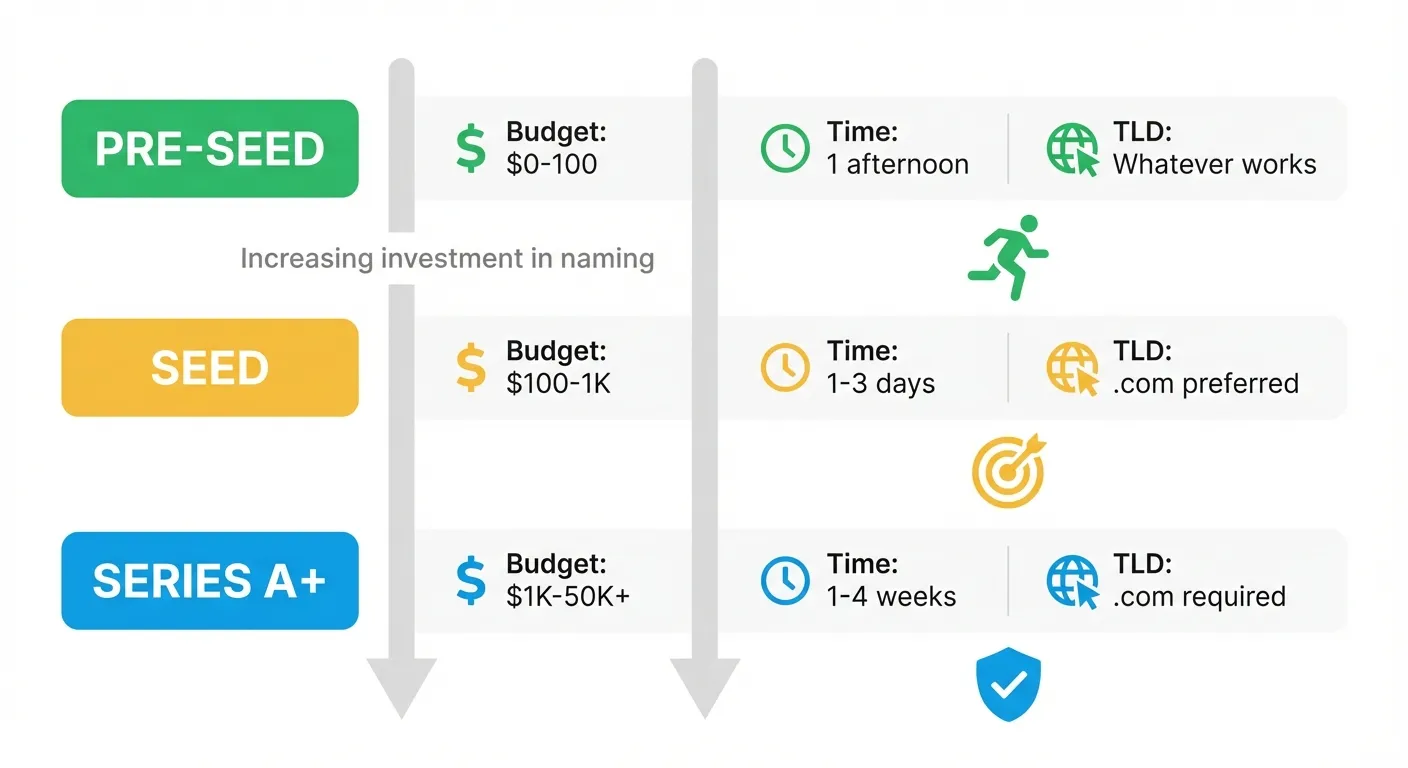
| Factor | Pre-Seed | Seed | Series A+ |
|---|---|---|---|
| Budget | $0-100 | $100-1,000 | $1,000-50,000+ |
| Time | 1 afternoon | 1-3 days | 1-4 weeks |
| TLD priority | Whatever's available | .com preferred, .io/.ai fine | .com strongly preferred |
| Trademark | Basic Google search | USPTO/WIPO search | Formal filing |
| Tools | AI naming tools, DIY | AI tools + domain broker | Agency + AI tools + legal |
| Defensive domains | Skip | Register 1-2 | Register 5-10 |
| Rebrand risk | High (expect it) | Moderate | Low (get it right now) |
The Bottom Line
Pre-seed: Name it fast, name it cheap, name it flexible. Don't let naming block your launch. You'll probably change it anyway.
Seed: Start thinking strategically. Invest a weekend in doing it properly. Check trademarks. Consider whether the name can survive a Series A pitch deck.
Series A+: This is the name that sticks. Budget for it accordingly. Upgrade the domain if needed. File trademarks. Align everything. The cost of getting it wrong compounds from here.
Whatever stage you're at, generating volume is the key to finding a strong name quickly. URLGenie produces 50 scored domain candidates per session with availability checking and risk analysis - whether you're a pre-seed founder spending an afternoon or a Series A company doing due diligence on their rebrand options.